A gabion box is a wire mesh container filled with durable stone and used to create retaining, erosion-control, slope-protection, and other civil engineering structures. Gabion boxes are widely used because they combine a strong stone mass with a flexible wire mesh system that can adapt to certain ground movements while allowing water to pass through the structure.
For projects in Saudi Arabia, selecting the right gabion box requires more than choosing a convenient basket size. The mesh opening, wire diameter, protective coating, dimensions, connections, stone grading, foundation, drainage, and intended application should all be considered together.
Gabion boxes can be used for retaining walls, road infrastructure, wadi protection, erosion control, slope stabilization, drainage works, landscaping, and other applications where a stone-filled wire structure is appropriate. This guide explains what gabion boxes are, how they are configured, where they are used, and what contractors, engineers, consultants, and procurement teams should check before selecting them.
What Is a Gabion Box?
A gabion box is a three-dimensional wire mesh unit assembled into a box or basket and filled with stone. Once filled and connected to adjacent units, individual gabion boxes can form larger structures. These structures can include:
- Retaining walls
- Slope protection systems
- Erosion-control structures
- Wadi protection
- Drainage-channel protection
- Roadside protection
- Landscaping walls
- Infrastructure protection
The wire mesh contains the stone while the stone provides the majority of the mass of the completed structure.
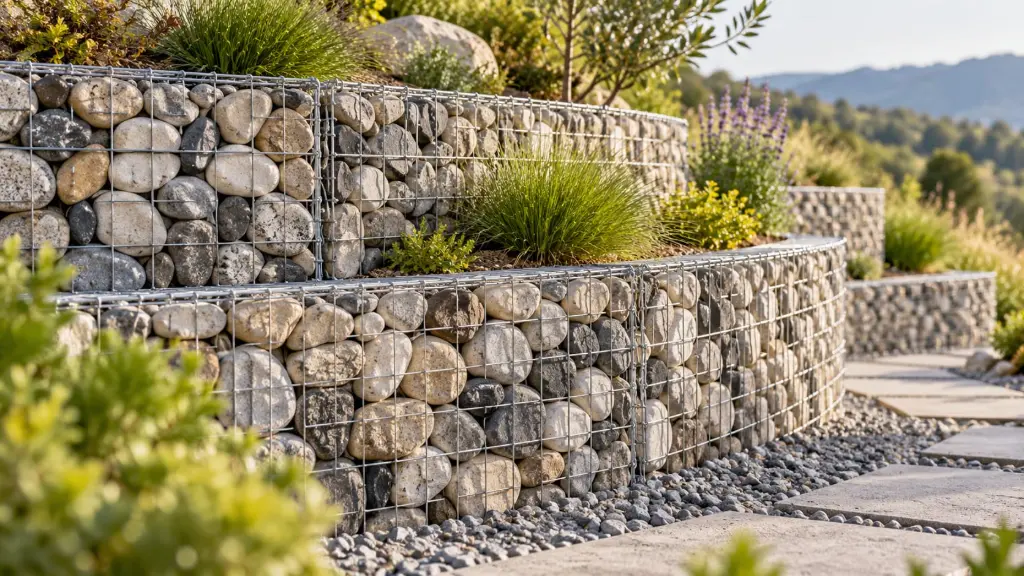
How Does a Gabion Box Work?
A gabion box works as part of a complete system rather than as an independent component. The basic arrangement is:
Wire mesh → connections → stone fill → connected gabion structure
The mesh holds the stone together. The connections join individual units and courses. The stone creates the mass required for the intended application. The surrounding foundation, backfill, drainage, and ground conditions also influence the performance of the finished structure. For this reason, selecting a gabion box should always begin with the application and project requirements.
Main Components of a Gabion Box
A typical gabion box can contain several components.
Wire Mesh
The mesh forms the main containment structure. Its specification can include:
- Mesh opening
- Wire diameter
- Mesh configuration
- Coating
Edge or Selvedge Wire
The perimeter can use reinforced edge wire to strengthen the panel and provide a suitable connection area.
Diaphragms
Longer gabion boxes may contain internal diaphragms that divide the unit into compartments and help maintain its shape.
Lacing Wire
Lacing wire can be used to assemble panels, connect units, and close the lid.
Mechanical Connectors
Depending on the product system, clips, spirals, rings, or other connectors may be used.
Stone Fill
The basket is filled with suitable durable stone that matches the mesh opening and project requirements.
Gabion Box Sizes
Gabion boxes are manufactured in different lengths, widths, and heights, with the required dimensions depending on factors such as the wall configuration, application, available space, required wall height, installation method, project drawings, and stone availability. There is no single gabion box size suitable for every project. The selected dimensions should be based on the approved product specification and properly coordinated with the engineering drawings to ensure suitability for the intended application.
Gabion Box Dimensions vs Wall Dimensions
A common procurement mistake is confusing the dimensions of an individual gabion box with the dimensions of the completed wall. A retaining wall may consist of multiple courses of gabion boxes, with the completed structure featuring a wider base, a narrower upper section, a stepped profile, a batter, different unit sizes, or varying course arrangements. Therefore, the overall wall dimensions and required profile should be established before selecting the exact combination and quantities of gabion boxes.
Gabion Box for Retaining Walls
Retaining walls are one of the most common applications for gabion boxes. A gabion retaining wall uses the mass of the stone-filled units to resist the forces generated by retained soil. The design should consider:
- Wall height
- Soil properties
- Surcharge
- Foundation conditions
- Groundwater
- Drainage
- Wall geometry
- Backfill
- Available space
The gabion box is only one component of the complete retaining-wall system.
Gabion Box for Slope Protection
Gabion boxes can be used in slope-protection projects where a three-dimensional stone-filled structure is appropriate. Applications may include:
- Slope toe protection
- Embankment protection
- Erosion control
- Retaining unstable ground
- Roadside slope protection
The overall slope should be assessed rather than treating the gabion box as a standalone solution. Depending on the slope condition, the project may also require drainage, geotextile, anchors, or other stabilization measures.
Gabion Box for Erosion Control
Gabion structures can help protect soil from erosion by providing a durable stone surface and retaining material in vulnerable areas. Common applications include riverbanks, wadi edges, drainage channels, culvert outlets, embankments, and sloped ground. The appropriate gabion system depends on the type and intensity of erosion present at the site. For surface and hydraulic protection, a Reno mattress may be more suitable than a conventional gabion box in certain applications, depending on the project requirements and site conditions.
Gabion Box for Wadi Protection
Wadi protection projects require careful consideration of water movement, as intense rainfall and rapid runoff can cause bank erosion, channel scour, soil loss, undermining, and damage around drainage structures. Gabion systems can be incorporated into suitable hydraulic protection designs to help address these conditions
The design should consider factors such as expected water flow, channel geometry, foundation conditions, stone size, mesh specification, erosion conditions, and potential upstream and downstream effects. A standard gabion box arrangement should not be used automatically in locations exposed to significant hydraulic forces; the system should instead be selected and designed according to the specific site and hydraulic requirements.
Gabion Box for Road and Highway Projects
Gabion boxes can support various road infrastructure applications, including retaining road embankments, protecting cut slopes, providing drainage-channel protection, protecting bridge approaches, controlling roadside erosion, and stabilizing slopes.
Road projects may involve additional loading from traffic and other infrastructure, so gabion walls should be designed with consideration of the road geometry, traffic loads, drainage requirements, and foundation conditions. Proper engineering assessment is essential to ensure the gabion system is suitable for the specific road application and site conditions.
Gabion Box for Landscaping
Gabion boxes are also widely used in landscaping because natural stone can create a distinctive and attractive architectural appearance. Common applications include garden retaining walls, boundary walls, raised planting areas, terraced gardens, decorative features, and outdoor seating structures. For landscaping projects, the selection of stone can have a significant impact on the overall finished appearance. However, when a gabion box is used to retain soil, the structure should still be provided with suitable foundation preparation and drainage considerations.
Gabion Box for Drainage Applications
Gabion structures can be incorporated into drainage and channel-protection works. Potential applications include:
- Channel lining
- Outlet protection
- Bank stabilization
- Culvert protection
- Scour protection
The suitability of the gabion system depends on the hydraulic conditions. Where water velocity or flow depth is significant, the design should be supported by appropriate hydraulic assessment.
Gabion Box Mesh Specifications
The mesh is one of the most important components of a gabion product. Its technical specification may include the mesh opening, wire diameter, mesh type, edge wire, coating, connection system, and diaphragm arrangement.
The selected mesh should be compatible with the intended stone size to ensure proper containment and structural performance. For detailed technical requirements, the project’s gabion basket specification should be reviewed alongside the manufacturer’s product documentation.
Gabion Box Wire Coating
Wire coating provides protection against corrosion. The required coating depends on:
- Environmental exposure
- Moisture
- Salinity
- Project requirements
- Expected service conditions
For coastal locations, the wire-protection specification deserves particular attention. Projects around Jeddah, Yanbu, Dammam, and Jubail may have different exposure conditions from inland projects. The coating should therefore be selected according to the actual project environment rather than using one specification for every location.
Gabion Box Stone Requirements
Stone is the main filling material used inside a gabion box and should be durable, suitable for the project environment, appropriately sized, compatible with the mesh opening, resistant to weathering, and suitable for the intended application. The final stone specification should be established in accordance with the project documentation and requirements. For visible landscaping walls, additional considerations such as the color, shape, and overall appearance of the stone may also be important.
Gabion Box and Stone Size Compatibility
Stone grading should be checked before installation. If the stone contains pieces that are too small for the selected mesh opening, material can escape through the mesh. If the stones are too large, the contractor may have difficulty filling the basket evenly. The contractor should therefore confirm:
Mesh opening + stone grading + basket dimensions
before filling begins.
Gabion Box Connection System
Adjacent gabion boxes must be properly connected. The connection system may include:
- Lacing wire
- Clips
- Spirals
- Rings
- Other approved connectors
The selected connection method should be compatible with the gabion product. The project specification should also identify the required connection system where applicable.
Gabion Box Diaphragms
Long gabion boxes can contain internal diaphragms. These divide the basket into sections and help maintain its geometry during filling. Diaphragms can also help reduce deformation of longer units during construction. Their spacing should be confirmed from the product specification.
Gabion Box Foundation Requirements
The foundation is an important part of a gabion retaining structure. Depending on the project requirements, foundation preparation may involve excavation, removal of unsuitable soil, subgrade preparation, compaction, leveling, and placement of suitable foundation material.
The exact foundation arrangement depends on the site conditions and project requirements. For retaining walls and major infrastructure projects, the foundation should be designed and prepared in accordance with the approved engineering design and available geotechnical information.
Gabion Box Drainage and Geotextile
Water management should be considered when gabion boxes retain soil. A project may require geotextile behind the structure to separate soil from the gabion and help prevent migration of fine particles. Drainage may also include:
- Drainage layers
- Toe drains
- Surface channels
- Outlets
- Culverts
The correct arrangement depends on the site. Gabion boxes are permeable, but permeability does not remove the need to properly manage surface and subsurface water.
Gabion Box Quality Inspection
Before installation, the supplied gabion boxes should be inspected to verify the correct dimensions, mesh condition, wire coating, edge wire, diaphragms, connections, quantity, and packaging condition. The stone should also be checked for appropriate size, durability, cleanliness, and compatibility with the mesh. Formal inspection should be carried out in accordance with the project’s approved quality-control procedure.
Gabion Box Quantity Calculation
For preliminary estimation, the required number of gabion boxes depends on factors such as wall length, wall height, number of courses, unit dimensions, and the overall wall profile. For a simple straight section, the quantity can be estimated by dividing the total wall length by the length covered by each unit.
However, final quantities should also account for corners, curves, changes in height, different courses, setbacks, openings, and site-specific conditions. For procurement purposes, the approved gabion schedule should be used rather than relying solely on a basic theoretical calculation.
Gabion Box vs Gabion Mattress
Gabion boxes and Reno mattresses serve different purposes. A gabion box is deeper and commonly used for retaining structures, gravity walls, and three-dimensional protection works. A Reno mattress is relatively shallow and can be used for surface erosion and hydraulic protection.
The choice depends on the engineering problem. Using the correct product for the actual application can improve both construction efficiency and system performance.
Conclusion
Gabion boxes provide a flexible way to build stone-filled retaining and protection structures, but the correct product must be selected according to the application. The box dimensions, mesh opening, wire diameter, coating, diaphragms, connections, stone, foundation, drainage, and wall configuration all need to work together.
For Saudi Arabia projects, the selection should also account for regional environmental conditions, terrain, soil, water movement, and project specifications. Whether the project is a retaining wall in Riyadh, slope protection in Taif, coastal infrastructure in Jeddah or Dammam, or wadi protection elsewhere in the Kingdom, the gabion box should be selected as part of the complete engineering solution.
Hitech Gabion provides gabion boxes and related earth-retention solutions for Saudi construction and infrastructure applications, supporting project teams with products for retaining, erosion-control, slope-protection, and related works.
Frequently Asked Questions
A gabion box is a wire mesh container filled with suitable stone. Multiple boxes can be connected to form retaining walls, erosion-control structures, and other civil engineering systems.
Gabion boxes can be used for retaining walls, slope protection, erosion control, wadi protection, road infrastructure, drainage protection, and landscaping.
Gabion boxes are manufactured in different lengths, widths, and heights. The suitable size depends on the product system and project requirements.
Durable stone of an appropriate size is used. The stone grading should be compatible with the mesh opening and project specification.
Foundation requirements depend on the site and design. A stable and properly prepared base is essential for retaining-wall applications.
Geotextile may be required behind a gabion retaining wall to provide soil separation and filtration. Its use depends on the project conditions and design.
Gabion boxes can be used for many Saudi applications, including retaining walls, slope protection, erosion control, wadi protection, road infrastructure, and landscaping, subject to suitable engineering design.
They can be used in coastal environments when the wire coating and complete product specification are selected for the expected environmental exposure.
The terms can vary between manufacturers. Both generally describe stone-filled wire mesh units. For procurement, the exact dimensions and technical specifications should be confirmed.