A gabion retaining wall is a gravity structure made from stone-filled wire mesh baskets or boxes. The weight of the stone provides resistance against the pressure of retained soil, while the open structure allows water to pass through the wall.
Gabion retaining walls are used across Saudi Arabia for road infrastructure, slope protection, landscaping, erosion control, wadi protection, and other civil engineering applications. Their suitability depends on the ground conditions, wall height, drainage, loading, basket configuration, and overall engineering design.
For contractors, consultants, and project managers, understanding these factors before procurement and construction can help avoid common problems such as incorrect basket dimensions, inadequate foundation preparation, poor drainage, and unsuitable stone.
What Is a Gabion Retaining Wall?
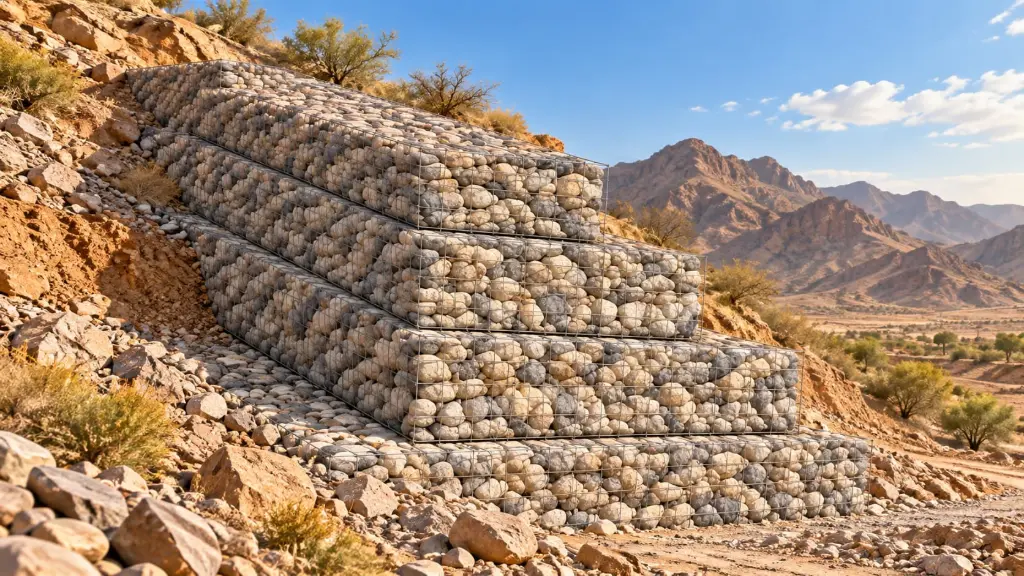
A gabion retaining wall consists of interconnected wire mesh units filled with durable stone and arranged according to the required wall profile. Unlike a conventional solid concrete wall, a gabion wall is made from individual units that work together as a mass. The stone provides the weight of the structure, while the mesh contains the stone and maintains the shape of each unit.
The wall can be constructed using multiple courses, with the lower courses generally forming a wider base and upper courses positioned according to the required design.
How Does a Gabion Retaining Wall Work?
The main principle is gravity. The completed stone-filled structure creates enough mass to resist the forces acting against the retained soil.
The wall also has an important drainage characteristic because water can move through the spaces between the stones. This can reduce water pressure within the retained area when the complete drainage arrangement is properly designed.
However, a gabion wall should not be considered automatically stable simply because it is permeable. Soil properties, groundwater, surcharge loads, foundation conditions, wall geometry, and drainage still need to be evaluated as part of the design.
Where Are Gabion Retaining Walls Used?
Gabion retaining walls can be used where changes in ground level need to be supported or protected. Common applications include road embankments, cut slopes, landscaping, drainage areas, wadi protection, and erosion-prone locations.
They can also be used where a natural stone appearance is preferred over a conventional concrete finish. The most appropriate application depends on the site conditions and engineering requirements rather than the product alone.
Gabion Retaining Wall Design Considerations
The design of a gabion retaining wall starts with understanding the site. Wall height is one of the most important factors, but it is not the only consideration. Soil properties, groundwater, surcharge loads, foundation conditions, available space, wall inclination, and drainage can all affect the required configuration.
The wall may require a wider base, stepped courses, or a battered face depending on the design. For larger or more heavily loaded structures, project-specific engineering calculations should determine the wall geometry and basket arrangement.
| Learn more about Gabion Retaining Wall Design in Saudi Arabia
Foundation Preparation
A stable foundation is essential for a gabion retaining wall. Before installation, unsuitable material may need to be removed and the foundation leveled and compacted. Depending on the project, suitable foundation material may also be required.
The foundation should provide a stable and reasonably uniform surface for the first course. Poor preparation can contribute to settlement, displacement, or changes in wall geometry. The exact foundation arrangement should follow the approved drawings and geotechnical requirements.
Drainage Behind a Gabion Wall
Although gabion structures are permeable, drainage behind the wall still requires attention. Water moving through retained soil can carry fine particles toward the gabion structure. A suitable geotextile or filter arrangement may therefore be required between the backfill and the gabion.
Depending on the project, additional drainage measures may also be necessary. The purpose is to control water movement while preventing excessive migration of soil particles. The correct arrangement depends on soil type, groundwater conditions, rainfall, and the project design.
Gabion Wall Stone Selection
Stone provides most of the mass of a gabion retaining wall, making its selection important. The stone should be durable and suitable for the expected environmental conditions. Its grading must also be compatible with the mesh opening so that the stone remains contained within the basket.
Poorly selected stone can make installation more difficult and may affect the appearance and geometry of the completed wall. For visible landscaping projects, the color and appearance of the stone may also be part of the specification.
Mesh and Wire Specification
The wire mesh needs to provide the required containment and durability for the intended application. Important specifications can include mesh opening, wire diameter, edge wire, protective coating, diaphragms, and connection components.
Coating selection deserves particular attention in Saudi Arabia. Inland and coastal environments can have different exposure conditions, particularly around areas such as Jeddah, Yanbu, Dammam, and Jubail. The selected coating should therefore follow the project's environmental and technical requirements.
Contact Us
Enquire Now — Gabion Retaining Wall Solutions
Gabion Retaining Walls in Saudi Arabia
Saudi Arabia offers a wide range of ground and environmental conditions, so retaining wall selection should be site-specific. In Riyadh, foundation conditions, soil, grading, and drainage can be important considerations. In Taif and other mountainous areas, steep terrain can require careful coordination between retaining walls, slopes, and drainage.
Coastal projects may require greater attention to corrosion protection, while wadi and drainage projects need to account for water movement and erosion. For major infrastructure developments, the gabion system should also comply with the project's approved specifications and quality-control requirements.
Gabion Retaining Walls for Roads
Gabion walls can be used to support road embankments, protect cut slopes, and manage changes in elevation along highways and access roads. Road projects introduce additional considerations because traffic loads, road levels, drainage structures, and construction activities can influence the retaining system.
The wall should therefore be designed and coordinated with the surrounding road infrastructure rather than treated as a standalone structure.
Gabion Retaining Walls for Landscaping
Gabion retaining walls are also suitable for landscaping projects where a natural stone appearance is desirable. They can create terraces, garden retaining walls, raised planting areas, and changes in ground level while providing a visually distinctive alternative to conventional retaining materials.
For landscape projects, the stone selection becomes especially important because the finished wall remains visible. The foundation and drainage should still be addressed where the wall retains soil.
Gabion Retaining Wall Construction
Construction normally begins with foundation preparation. The first gabion course is then positioned and connected before being filled with the specified stone. During filling, the basket shape should be maintained and the stone placed carefully to avoid excessive deformation. Diaphragms and internal connections should be installed according to the product specification.
Once the unit is filled, the lid is secured and the basket is connected to adjacent units. Additional courses are then installed according to the approved wall profile. Backfilling and drainage work should progress alongside the wall construction rather than being treated as unrelated activities.
Common Gabion Retaining Wall Problems
Many problems can be avoided through proper planning before construction begins. One common issue is selecting basket dimensions without first confirming the wall design. Another is using unsuitable or poorly graded stone that does not work effectively with the mesh.
Foundation preparation is also important. A strong-looking basket cannot compensate for an unstable or poorly prepared base. Drainage is another area that deserves attention. Although gabions allow water to pass through, retained soil still requires appropriate filtration and drainage where site conditions demand it.
Gabion Retaining Wall vs Concrete Wall
Gabion and concrete retaining walls have different characteristics. A concrete wall provides a relatively rigid structure, while a gabion wall consists of connected stone-filled units. Gabions can provide a more natural appearance and allow water to pass through the stone-filled structure.
The choice depends on the wall height, soil conditions, available space, loading, appearance, drainage requirements, construction method, and project specification. Neither system should be selected solely because it is cheaper or easier to install.
Why Choose Hitech Gabion?
Hitech Gabion provides gabion solutions for retaining, erosion control, slope protection, wadi protection, landscaping, drainage, and infrastructure applications across Saudi Arabia.
Its range includes gabion baskets, gabion boxes, gabion mesh, and related protection systems. These products can support contractors, consultants, engineers, and procurement teams working on projects that require stone-filled retaining and protection structures. The correct product and configuration should always be coordinated with the approved engineering drawings, site conditions, and project specifications.
Conclusion
Gabion retaining walls provide a practical solution for many Saudi construction and infrastructure applications. Their combination of stone mass, flexible wire mesh, permeability, and natural appearance makes them suitable for retaining, slope protection, erosion control, road infrastructure, and landscaping.
Successful performance depends on treating the wall as a complete system. Foundation preparation, basket dimensions, mesh specification, stone grading, drainage, geotextile, wall geometry, and site conditions all need to be considered together.
Frequently Asked Questions
A gabion retaining wall is a wall made from interconnected wire mesh baskets or boxes filled with stone. The mass of the stone provides resistance against retained soil.
Yes. They can be used for suitable retaining, erosion-control, road, landscaping, slope, and infrastructure applications across Saudi Arabia when properly designed for the site.
Drainage requirements depend on the soil and groundwater conditions. Geotextile and additional drainage measures may be required behind the wall to manage water and prevent soil migration.
Durable stone with suitable grading is used. The stone must be compatible with the selected mesh opening and the project's technical requirements.
Yes. They can be used for road embankments, slope protection, retaining applications, and erosion control when designed for the relevant site and loading conditions.