Gabion retaining walls provide a flexible solution for retaining soil, stabilizing slopes, protecting infrastructure, and controlling erosion. Their stone filled construction allows the wall to function as a gravity structure while also providing natural drainage through the gabion fill.
In Saudi Arabia, gabion retaining walls can be considered for highways, road embankments, wadi protection, landscaping, industrial developments, mountain roads, and other projects where changes in ground level create a need for soil retention.
However, choosing the right gabion size alone does not constitute a retaining wall design. The wall must be assessed according to the site conditions, retained soil, loads, foundation, drainage, wall geometry, and environmental exposure.
This guide explains the key engineering considerations involved in gabion retaining wall design and the factors that should be reviewed before construction.
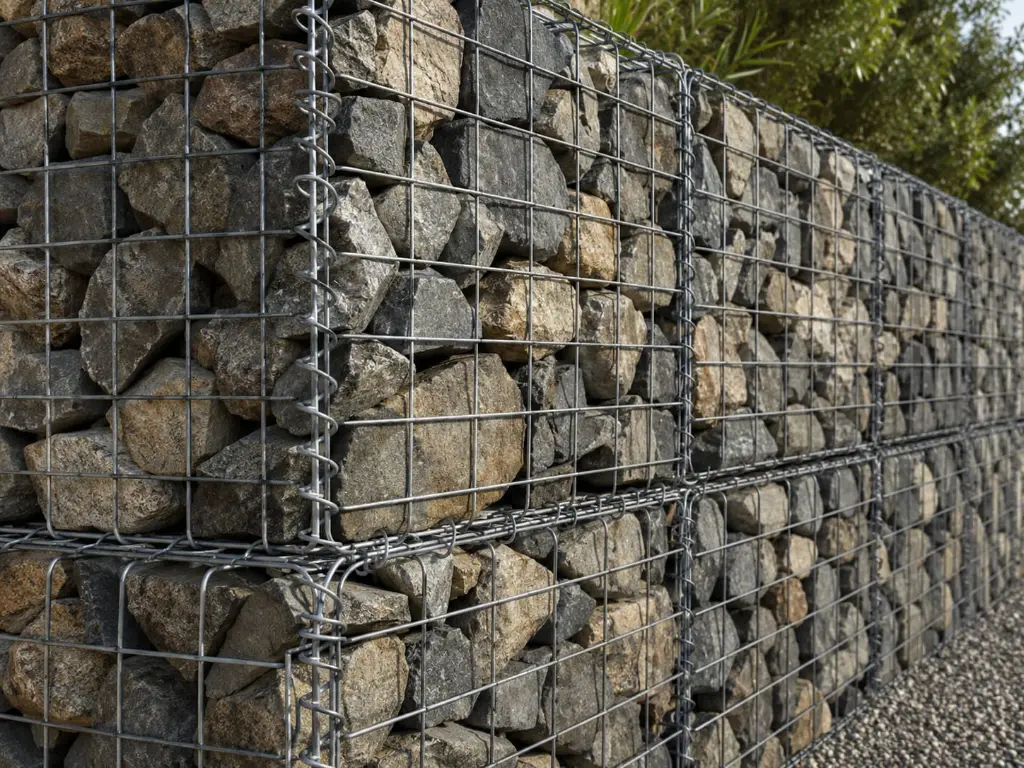
What Is a Gabion Retaining Wall?
A gabion retaining wall is a gravity retaining structure made from interconnected wire mesh units filled with durable stone.
The combined weight of the gabion units and stone provides resistance against the pressure exerted by retained soil.
Unlike many solid retaining structures, gabion walls are permeable. Water can move through the stone filled structure, which can help reduce hydrostatic pressure when the surrounding drainage and filter system are properly designed.
The wall can be built in stepped courses or with a battered profile depending on the required height, site conditions, and engineering design.
How Does a Gabion Retaining Wall Work?
Retained soil naturally exerts lateral pressure against the wall.
The gabion structure resists this pressure primarily through its own mass and geometry.
A properly designed wall should provide sufficient resistance against the relevant forces acting on it, including:
- Lateral earth pressure
- Surcharge loads
- Water pressure
- Sliding forces
- Overturning forces
- Foundation pressure
- Soil movement
The wall configuration must therefore be selected according to the actual project conditions.
Key Factors in Gabion Retaining Wall Design
1. Retained Soil
The properties of the retained soil directly influence the pressure acting on the wall.
A geotechnical assessment may consider:
- Soil classification
- Unit weight
- Shear strength
- Internal friction
- Cohesion where applicable
- Groundwater
- Existing ground conditions
- Backfill material
The design should use reliable project specific soil information wherever available.
A retaining wall designed without understanding the underlying and retained soil conditions can have an unnecessarily conservative or inadequate configuration.
2. Wall Height
Wall height has a major influence on the forces acting on the structure.
As height increases, the wall generally experiences greater earth pressure and may require a larger base, additional courses, or a different configuration.
There is no universal gabion wall width or height suitable for every project.
A low landscaping wall, for example, has very different requirements from a retaining wall supporting a highway embankment.
For taller walls and infrastructure applications, project specific engineering calculations are essential.
3. Wall Geometry
Gabion retaining walls can be constructed using different geometries.
A common approach is a stepped or battered arrangement in which each course is positioned to create a stable overall profile.
The design may define:
- Overall wall height
- Base width
- Top width
- Course height
- Setback
- Batter
- Gabion unit dimensions
- Foundation level
The selected geometry should provide the required stability while also fitting within the available site area.
4. Foundation Conditions
The foundation supports the entire wall.
Before construction, the foundation area should be investigated and prepared according to the project requirements.
Typical preparation may include:
- Removing unsuitable material.
- Excavating to the required elevation.
- Leveling the foundation.
- Compacting the subgrade or approved foundation material.
- Installing specified foundation or filter materials.
- Establishing the correct wall alignment.
Foundation conditions are particularly important where the site contains weak, loose, saturated, or highly variable soils.
5. Sliding Stability
A retaining wall can experience horizontal forces that attempt to move it forward.
The wall's mass, base configuration, foundation interaction, and other design factors contribute to resistance against sliding.
The available resistance should be checked against the design forces.
For complex or heavily loaded structures, the sliding assessment should be carried out as part of the complete retaining wall design.
6. Overturning Stability
Earth pressure and other loads can also create a rotational force around the wall's base.
The wall geometry and mass need to provide sufficient resistance against overturning.
The location of the resultant forces and the foundation conditions are important parts of this assessment.
A generic wall dimension should therefore not be applied to a project without checking the actual loading and site conditions.
7. Bearing and Foundation Pressure
The weight of the gabion wall transfers load to the foundation.
The foundation soil must be capable of supporting the structure without unacceptable settlement or bearing failure.
Engineers may need to consider:
- Allowable bearing capacity
- Contact pressure
- Foundation width
- Soil settlement
- Ground improvement
- Differential settlement
The required assessment depends on the wall and the characteristics of the site.
8. Drainage Behind the Wall
Drainage is a critical component of retaining wall design.
Water accumulating behind a retaining wall can increase pressure against the structure.
Gabions naturally provide permeability because water can move through the stone filled units. However, the drainage arrangement behind the wall still needs to be properly considered.
Depending on the soil and project requirements, the system may incorporate:
- Geotextile filter fabric
- Granular drainage material
- Surface drainage
- Toe drainage
- Water outlets
- Channel protection
The purpose of a filter layer is to allow water movement while limiting migration of fine soil particles.
9. Geotextile Behind a Gabion Retaining Wall
A geotextile can play an important role where the retained soil contains fine particles.
Installed between the soil and the gabion structure, an appropriate filter layer can help:
- Separate soil from stone
- Control soil migration
- Improve filtration
- Support drainage
- Maintain the integrity of the surrounding soil
The correct geotextile should be selected according to the soil, water conditions, and project specification.
It should not be treated as a one size fits all component.
10. Surcharge Loads
The area above a retaining wall may carry additional loads.
Examples can include:
- Roads
- Vehicles
- Buildings
- Stored materials
- Equipment
- Other structures
These loads can increase pressure on the retaining wall.
A gabion wall supporting an ordinary landscaped area should therefore not automatically be used for a road or industrial application without reassessing the loads.
Gabion Retaining Wall Design for Roads
Road projects often require retaining structures because construction changes the natural ground profile.
Gabion retaining walls may be considered for:
- Road embankments
- Road widening
- Cut slopes
- Access roads
- Drainage channels
- Bridge approaches
- Erosion protection
The design needs to account for traffic related loads, road drainage, slope geometry, and the consequences of potential wall movement.
Gabion Retaining Wall Design for Slopes
Gabion retaining walls can be useful on sloping sites where soil needs to be retained or surface erosion needs to be controlled.
However, the wall and the slope should be considered together.
A retaining wall may address local soil retention while the overall site still requires:
- Slope stability assessment
- Surface drainage
- Erosion protection
- Toe protection
- Soil reinforcement
- Other stabilization measures
For steep or complex slopes, the retaining wall should form part of an integrated geotechnical solution.
Gabion Retaining Walls for Wadi Protection
Saudi Arabia's wadis can experience rapid water movement during periods of intense rainfall.
This can create erosion along banks, channels, and infrastructure crossings.
Gabion retaining walls can be used in some wadi applications to retain soil and protect vulnerable areas.
However, where the primary concern is direct hydraulic erosion, a shallow system such as a Reno mattress may be more appropriate for surface and channel protection.
The choice depends on whether the project requires soil retention, hydraulic protection, or both.
Gabion Retaining Wall Design for Saudi Arabia
Saudi Arabia contains a wide variety of environmental and geographic conditions.
A retaining wall design should therefore respond to the actual project location rather than assuming identical conditions throughout the Kingdom.
Inland Projects
Projects around Riyadh and other inland areas should consider the local soil, ground profile, drainage requirements, and potential intense rainfall events.
Coastal Projects
Developments around Jeddah, Dammam, Jubail, Yanbu, and other coastal areas may require additional attention to corrosion protection because of marine exposure and salinity.
Mountainous Projects
Areas such as Taif and Abha can involve significant changes in elevation and challenging slopes. Retaining wall design may need to be coordinated with broader slope stabilization measures.
Major Infrastructure Developments
Large highway, industrial, tourism, and development projects should use project specific geotechnical and structural requirements rather than generic gabion wall dimensions.
Gabion Wall Materials
The performance of the completed wall depends on both the gabion units and the stone fill.
Wire Mesh
The mesh must be suitable for the intended application and stone size.
Wire Coating
Galvanized or PVC coated wire may be selected according to the project's environmental exposure and required corrosion resistance.
Stone
The fill should be durable, appropriately sized, and resistant to weathering.
Connections
Lacing wire, connecting components, and other fastening methods should provide secure connections between units.
The final specifications should follow the project requirements.
Gabion Retaining Wall Construction
Once the design has been approved, installation should follow the project's drawings and specifications.
A typical construction sequence includes:
Site Preparation
Establish the wall alignment and prepare the work area.
Foundation Preparation
Excavate and prepare the foundation to the required level.
Filter Installation
Install the specified geotextile or filter system where required.
Gabion Assembly
Assemble the gabion units and secure their connections.
First Course
Position the first course accurately on the prepared foundation.
Stone Filling
Fill each unit with the specified stone while maintaining its shape and alignment.
Closing the Units
Secure the lids and connections after filling.
Additional Courses
Connect and install subsequent gabion courses according to the approved design.
Backfilling
Place and compact the backfill according to the project specification.
Final Inspection
Inspect the finished wall for alignment, connections, stone placement, profile, and drainage.
Gabion Retaining Wall vs Concrete Retaining Wall
Gabion and concrete retaining walls use different structural approaches.
A gabion wall relies primarily on its mass and geometry, while reinforced concrete retaining walls generally rely on structural reinforcement and concrete.
Gabions can offer advantages where permeability, flexibility, natural appearance, and erosion resistance are important.
Concrete may be more appropriate for applications requiring a different structural configuration or architectural finish.
The right solution depends on the project's engineering requirements, available space, soil conditions, loads, construction method, and environmental conditions.
When Should You Consider a Gabion Retaining Wall?
A gabion retaining wall may be worth considering when a project requires:
- Soil retention
- Slope support
- Erosion control
- Drainage through the structure
- Flexible construction
- Natural stone appearance
- Infrastructure protection
- Wadi or drainage protection
The suitability should always be confirmed through the project's engineering assessment.
How to Choose a Gabion Retaining Wall Supplier in Saudi Arabia
Before selecting a supplier, project teams should review more than the product price.
Important factors include:
- Gabion mesh quality
- Wire specification
- Corrosion protection
- Available unit sizes
- Stone requirements
- Connection systems
- Technical documentation
- Project supply capacity
- Delivery capability
- Technical support
- Previous project experience
For infrastructure projects, the supplier should be able to provide clear product information that matches the project's approved specifications.
Why Choose Hitech Gabion?
Hitech Gabion provides gabion and earth retention solutions for projects in Saudi Arabia.
Its solutions support applications including:
- Retaining walls
- Gabion walls
- Slope protection
- Erosion control
- Wadi protection
- Infrastructure protection
- Landscaping
Hitech Gabion can support project teams looking for gabion products and related erosion control solutions for Saudi construction and infrastructure applications.
For a project specific retaining wall, the product selection should be coordinated with the approved engineering design and site requirements.
Quick Wrap-up
Gabion retaining wall design requires a coordinated approach that considers the complete site rather than only the gabion baskets.
Soil, wall height, geometry, foundation, drainage, surcharge loads, stone, wire specification, and environmental exposure all influence the final solution.
For Saudi Arabian projects, engineers should also consider regional differences in terrain, rainfall, coastal exposure, and soil conditions.
When properly designed and installed, gabion retaining walls can provide flexible and durable solutions for soil retention, slope stabilization, erosion control, and infrastructure protection.
Hitech Gabion provides gabion systems and related earth retention solutions for construction and infrastructure applications across Saudi Arabia.
Frequently Asked Questions
A gabion retaining wall is designed by considering factors such as retained soil, wall height, geometry, foundation conditions, drainage, surcharge loads, material properties, and required stability checks.
There is no universal thickness. The required base width and wall geometry depend on the wall height, soil conditions, loading, foundation, and engineering requirements.
Gabion walls are permeable, but drainage must still be considered as part of the overall design. A geotextile or filter layer may be required to control soil migration.
Gabion retaining walls can be considered for road and highway applications, but the design must account for traffic surcharge, road geometry, drainage, foundation conditions, and other project-specific loads.
Yes. Gabion retaining walls can be used on sloping sites, but the wall should be assessed together with the overall slope stability.
Yes. Gabion retaining walls can be suitable for many Saudi applications, including roads, slopes, wadis, landscaping, and infrastructure. The design and material specification should reflect the actual local site conditions.
They serve different purposes. A gabion wall is generally used for retaining soil and creating a gravity structure, while a Reno mattress is a shallow system primarily used for surface and hydraulic erosion protection.