Gabion retaining walls are widely used in civil engineering and landscaping projects because they combine stone fill with wire mesh to create flexible, permeable structures. However, the performance of a gabion wall depends on more than the quality of its baskets and stones. The interaction between the retained soil, drainage system, and wall is equally important.
Geotextiles can play a valuable role in this system by separating soil from the stone fill, allowing water to pass through, and reducing the migration of fine soil particles. For construction projects in Saudi Arabia, selecting the correct geotextile is particularly important where soil characteristics, runoff, drainage conditions, and site exposure vary.
This guide explains how geotextile works with gabion retaining walls, which types are commonly considered, and what contractors and consultants should check before specifying or installing the material.
What Is Geotextile in Gabion Construction?
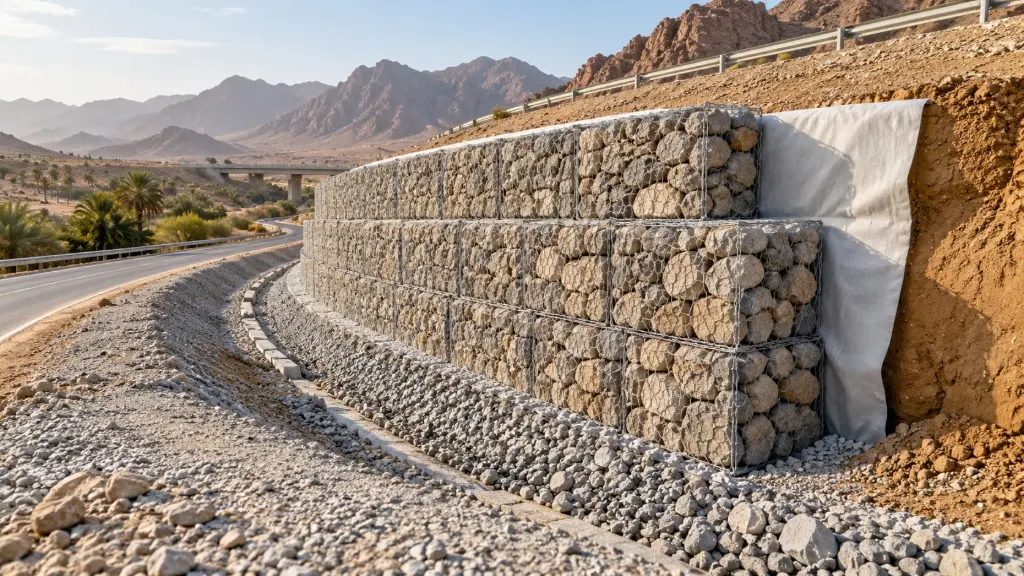
Geotextile is a permeable synthetic fabric used in civil engineering applications involving soil, drainage, filtration, separation, and reinforcement. In gabion construction, a suitable geotextile is often installed between the retained soil and the stone-filled structure or at other locations specified in the engineering design.
Its main function is to allow water to pass while limiting the movement of soil particles. Without an appropriate filter, fine soil may migrate through the gaps between gabion stones, potentially creating voids behind the wall and contributing to settlement or loss of backfill.
Geotextile does not replace the gabion mesh, structural design, or drainage system. It performs a separate function within the overall retaining wall assembly.
Why Do Gabion Retaining Walls Need Geotextile?
Gabion walls are permeable, but the gaps between the stones do not automatically provide adequate filtration for every soil type. Fine particles can move through the stone fill when water flows from the retained soil towards the wall.
A properly selected geotextile helps manage this interface.
Soil separation: It reduces the mixing of retained soil with the gabion stone fill, helping maintain the intended material arrangement.
Filtration: It allows water to pass while retaining soil particles within the limits established by the filter design.
Drainage support: It can help water move towards the drainage path without allowing excessive soil migration. The actual drainage capacity depends on the fabric's properties and the surrounding materials.
Reduced risk of backfill loss: By controlling particle migration, a suitable filter can help reduce the formation of voids behind the wall.
These benefits depend on selecting the fabric for the actual soil and hydraulic conditions. Installing an unsuitable geotextile can restrict flow, allow fine particles to pass, or create a filter interface that does not perform as intended.
Types of Geotextile Used with Gabion Walls
1. Nonwoven Geotextile
Nonwoven geotextiles are manufactured by bonding synthetic fibres into a permeable fabric. They are commonly considered for filtration, separation, and drainage-related applications.
Behind a gabion retaining wall, a suitable nonwoven product may allow water to pass from the soil while limiting the migration of fine particles. Its suitability depends on characteristics such as apparent opening size, permeability, tensile strength, puncture resistance, and the soil gradation.
Nonwoven geotextiles are not interchangeable across all projects. The selected product should meet the filter criteria established by the engineer.
2. Woven Geotextile
Woven geotextiles are produced by interlacing yarns or tapes into a regular fabric structure. Depending on their construction, they can provide high tensile strength and dimensional stability.
They may be suitable for selected separation or reinforcement applications. However, not every woven product is appropriate for filtration behind a gabion wall. The fabric's opening size and hydraulic properties must be checked against the retained soil and expected water flow.
Where filtration is the primary purpose, the design team should select the product based on performance requirements rather than choosing woven or nonwoven material by name alone.
3. Geotextile for Drainage and Separation Systems
Some retaining wall designs require geotextile to work alongside granular drainage material, perforated drainage pipes, or other drainage components. In these arrangements, the fabric may separate soil from a drainage layer while allowing water to enter the drainage path.
The complete system must be designed to manage groundwater and surface water safely. Geotextile alone should not be assumed to remove hydrostatic pressure if the wall lacks an adequate outlet or drainage arrangement.
How to Select Geotextile for Saudi Arabian Projects
Saudi Arabia has varied soil and environmental conditions, from sandy soils in desert areas to finer soils, weathered ground, and coastal deposits. The appropriate geotextile therefore depends on the site investigation and retaining wall design, not simply the project's location.
The following factors should be reviewed before procurement.
Selection factor | What the project team should check |
Soil gradation | Particle-size distribution and the risk of fine-particle migration |
Filtration properties | Apparent opening size and compatibility with the retained soil |
Water flow | Permittivity or permeability requirements under the expected conditions |
Mechanical strength | Tensile, puncture, and installation-damage resistance |
Drainage arrangement | Whether water can move safely through and away from the wall system |
Installation conditions | Contact with stone, overlaps, placement, and potential fabric damage |
Compliance | Applicable project specifications and required test documentation |
A geotechnical engineer should establish the filter criteria and determine whether additional drainage or reinforcement is required. Product selection should be based on documented properties and relevant test methods rather than fabric thickness or weight alone.
Geotextile Installation Behind a Gabion Retaining Wall
Correct installation is essential because gaps, tears, poor overlaps, or an unsuitable connection to the drainage system can compromise filtration.
First, prepare the foundation and backfill interface according to the approved drawings. Remove sharp debris and materials that could damage the fabric during placement.
Next, position the geotextile along the specified interface between the retained soil and gabion structure. The fabric should cover the intended filtration area, with overlaps or connections installed according to the manufacturer's instructions and project details.
Install the gabion baskets, stone fill, and backfill in the approved sequence. During construction, prevent machinery, sharp stones, or excessive dragging from puncturing or tearing the fabric. Backfill should be placed and compacted in controlled layers using methods appropriate to the wall design.
Finally, inspect the installation before the fabric becomes inaccessible. Check its continuity, overlaps, damage, and connection to any specified drainage components. Repairs and replacement of damaged sections should follow the approved method statement. The contractor should not change the fabric type, overlap arrangement, or drainage detail without the required technical approval.
Common Geotextile Selection and Installation Mistakes
One common mistake is selecting a geotextile solely by its GSM, or mass per unit area. GSM is useful for identifying a product's weight, but it does not independently establish filtration performance, permeability, or resistance to installation damage.
Another mistake is treating all gabion walls as identical. A landscape wall with limited retained soil may have different requirements from a retaining structure supporting a road embankment. Soil properties, water conditions, loading, and design life should determine the specification.
Poor drainage is another risk. Even a suitable filter cannot compensate for a drainage system that is blocked, undersized, or unable to discharge water safely. Likewise, a fabric that is too open for the soil may permit particle loss, while an unsuitable fabric may restrict the required flow.
For Saudi infrastructure projects, the technical submittal should identify the geotextile's intended function, relevant properties, test documentation, and compatibility with the approved design.
Where Is Geotextile Used with Gabion Walls in Saudi Arabia?
Geotextile may be specified for gabion retaining walls in road embankments, commercial developments, industrial facilities, landscaping projects, and selected infrastructure works across Saudi Arabia.
For highway projects, it can help separate backfill from the gabion structure where filtration is required. In landscaping and site development, it may reduce soil migration behind decorative or functional retaining walls. In areas exposed to concentrated runoff, the engineer should also assess surface-water management and erosion risks around the structure.
For projects in Riyadh, Jeddah, Dammam, Jubail, NEOM, and other regions, the geotextile should be selected according to the actual ground conditions and project requirements. Coastal exposure may influence material durability, while soil gradation and groundwater conditions remain central to filter selection.
Conclusion
Geotextile is an important component of many gabion retaining wall systems because it can help control soil migration, support filtration, and maintain separation between backfill and stone fill. Its effectiveness depends on choosing a product compatible with the soil, water conditions, and design requirements.
For Saudi Arabian construction projects, contractors and consultants should confirm the geotextile specification before procurement and coordinate its installation with the gabion wall and drainage details. Hitech Gabion provides gabion solutions for infrastructure and landscaping applications, and project teams can contact its technical or sales team to discuss product requirements and obtain relevant documentation.
Frequently Asked Questions