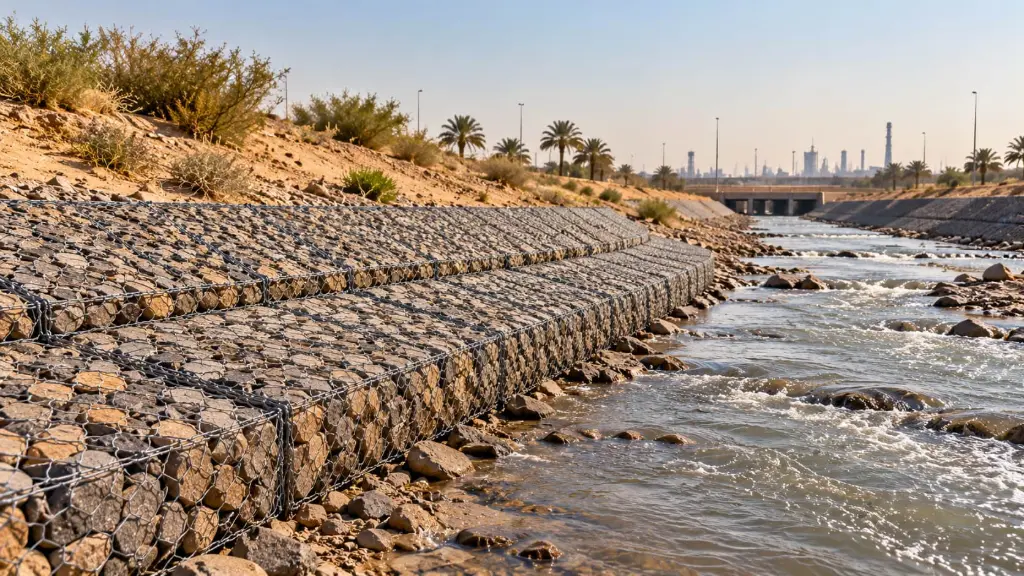
Gabion mattresses are low profile wire mesh structures filled with stone to protect exposed ground from erosion, stabilize embankments, and control scour around drainage channels and other infrastructure. Unlike conventional gabion baskets, which are generally deeper and used for retaining structures, gabion mattresses provide a relatively thin protective layer over a wider surface.
In Saudi Arabia, gabion mattresses can be useful for projects involving wadi channels, road embankments, drainage infrastructure, culvert outlets, and selected coastal or water management applications. Their suitability depends on flow conditions, soil characteristics, foundation preparation, stone grading, and the corrosion protection specified for the project.
For contractors, consultants, and procurement teams, selecting the right gabion mattress involves more than choosing a standard size. The mesh type, mattress thickness, wire coating, connections, and installation details must work together to provide the required protection.
What Is a Gabion Mattress?
A gabion mattress is a shallow, stone filled wire mesh unit designed to protect a surface against erosion and ground movement. It is commonly manufactured from double twisted hexagonal wire mesh or, for suitable applications, welded wire mesh. Internal diaphragms divide the unit into compartments to help maintain the distribution of stone during filling and service.
Once installed, the stone creates a protective layer over the prepared ground. The spaces between the stones allow water to pass through, while the mesh helps retain the fill. This permeability can reduce the buildup of water pressure within the protective layer, provided that the foundation, filter system, and drainage details are appropriately designed.
Gabion mattresses are often called Reno mattresses when referring to a particular type of mattress system. The term is widely used in civil engineering, although product specifications and construction details can vary between manufacturers.
Why Gabion Mattresses Matter for Saudi Arabian Projects
Saudi Arabia experiences intense rainfall events in some regions, rapid runoff through wadis, and erosion risks around drainage infrastructure. Even in predominantly dry environments, short periods of concentrated water flow can displace soil, undermine embankments, and damage exposed ground.
Gabion mattresses can provide a flexible form of surface protection where the engineering design supports their use.
Wadi and channel protection: Mattresses can line suitable channel beds and banks to help resist erosion caused by flowing water. Hydraulic design must account for flow velocity, shear stress, turbulence, and potential scour.
Road embankments and culvert outlets: Concentrated runoff near culverts and drainage outlets can erode soil and expose foundations. A properly designed mattress apron can help protect vulnerable surfaces and distribute flow related forces.
Slope and embankment protection: Mattresses can cover exposed slopes where surface erosion is a concern. The slope must be checked for stability, and the design may require anchorage, toe protection, drainage, or additional reinforcement.
Coastal and water infrastructure: Some mattress systems are suitable for selected shoreline and scour protection applications. Saltwater exposure, wave action, sediment movement, and corrosion requirements must be evaluated before specifying the product.
The important distinction is that gabion mattresses protect surfaces; they do not automatically solve deeper geotechnical instability or replace the hydraulic design of a drainage system.
Types of Gabion Mattresses
1. Double Twisted Gabion Mattresses
Double twisted mattresses use pairs of steel wires twisted together to form hexagonal mesh openings. This construction provides flexibility, which can help the mattress accommodate localized settlement and changes in ground contours without immediately losing its overall form.
These mattresses are commonly considered for channel linings, bank protection, erosion control, and selected hydraulic works. The mesh opening, wire diameter, edge wire, lacing system, and coating must be selected according to the project requirements.
For hydraulic applications, ASTM A975 is a relevant specification for double twisted wire mesh gabions and revet mattresses. The project documents should identify the applicable edition and any additional requirements.
2. Welded Gabion Mattresses
Welded mattresses use steel wires joined at their intersections to create a regular grid. Their rigid panels can offer consistent dimensions and shape control, which may be useful for certain landscaping and engineered surface protection applications.
However, welded and double twisted products are not automatically interchangeable. Their behavior under deformation, connection details, mesh construction, and suitability for flowing water applications differ. The consultant should approve the mesh system for the intended conditions.
3. Corrosion Protected Gabion Mattresses
Gabion mattresses may be supplied with galvanized wire, zinc aluminium alloy coatings, or additional polymer coatings, depending on the product range.
Galvanized wire provides a zinc based protective layer. Zinc aluminium alloy coatings may offer enhanced corrosion resistance under certain exposure conditions, while polymer coatings add another protective barrier when correctly manufactured and maintained.
For Saudi projects near the Red Sea or Arabian Gulf, coating selection should consider chloride exposure, water chemistry, abrasion, required service life, and the specified standard. No coating should be treated as universally suitable for every marine or aggressive environment.
Gabion Mattress Sizes and Specifications
Gabion mattress dimensions vary according to the manufacturer, mesh system, application, and applicable standard. Buyers should confirm the exact product series and approved project requirements before ordering.
| Parameter | What to Confirm |
|---|---|
| Length, Width and Thickness | Dimensions shown on approved drawings and product data |
| Mesh Construction | Double twisted or welded, as required by the design |
| Mesh Opening | Compatible with the specified stone grading |
| Wire Diameter | Mesh, edge, and lacing wire dimensions |
| Coating | Metallic coating and any additional polymer layer |
| Compartments | Number and spacing of internal diaphragms |
| Stone Fill | Required grading, durability, and placement requirements |
| Standard | Applicable product standard and project-specific requirements |
How to Select the Right Mattress Thickness
Mattress thickness should be based on engineering requirements rather than a general rule of thumb. The design may need to consider the expected hydraulic forces, stone size and density, channel geometry, foundation conditions, slope angle, and potential scour.
A thinner mattress may be suitable for some surface protection applications, while more demanding conditions may require a thicker system or additional protection measures. Increasing thickness alone does not guarantee stability if the toe, edges, foundation, or connections are inadequately designed.
Contact Us
Enquire Now — Gabion Mattresses for Erosion Control
For channels and drainage structures, the designer should assess flow velocity and the forces acting on the lining. For slopes, the assessment should include surface runoff, ground movement, and the stability of the underlying soil.
Where erosion may undermine the lower edge of a mattress, the design may require a protected toe or an apron that can accommodate expected scour. These details are especially important around culvert outlets and channel transitions.
Installation Considerations for Long Term Performance
Correct installation is essential to the performance of gabion mattresses. Even a well manufactured product can fail prematurely if the foundation is uneven, the mesh is damaged, or the stone is placed incorrectly.
First, prepare the foundation to the approved profile and remove unsuitable material. Where required by the design, install a suitable geotextile or filter layer to limit the migration of fine soil through the stone structure. The filter must be selected for the soil and hydraulic conditions rather than added as a substitute for proper design.
Next, unfold and assemble the mattress, connect adjoining units, and secure the edges according to the manufacturer's instructions. Check the alignment, compartments, fasteners, and anchorage before filling. Place stone carefully and distribute it across compartments to reduce voids and uneven loading. Close and secure the lid using the specified lacing or fastening system.
Finally, inspect the completed installation for gaps, exposed edges, damaged coatings, loose connections, and areas where water could bypass the protection. The contractor should document inspections and obtain approval at the project’s specified hold points.
ASTM D7014 provides installation guidance for double twisted wire mesh gabions and revet mattresses. The applicable contract documents and approved method statement should govern the actual site procedure.
Gabion Mattresses vs Gabion Baskets
Both products use stone filled wire mesh, but they serve different primary functions.
Gabion baskets are deeper units commonly used to construct retaining walls, gravity structures, and other applications requiring substantial stone filled sections. Gabion mattresses are shallower and cover a wider area, making them suitable for designed surface protection and erosion control.
A mattress may be used at the base of a slope or channel while gabion baskets provide a separate retaining function nearby. Such combinations require coordinated design, especially where water flow, settlement, or scour may affect both systems.
Choosing between them should begin with the engineering objective: surface protection, retaining support, or a combination of functions.
What Should Contractors Check Before Purchasing?
Before requesting a quotation, contractors and procurement teams should prepare the project drawings, required quantities, mattress dimensions, mesh type, coating requirements, stone specifications, and applicable standards. The enquiry should also identify the installation location and any exposure to saline water, aggressive soil, or high velocity flow.
Ask the supplier for product data, dimensional details, coating information, relevant compliance documents, and installation guidance. Confirm whether the quoted product matches the consultant approved specification, including its lacing components and accessories.
For projects in Riyadh, Jeddah, Dammam, NEOM, or other Saudi locations, the specification should reflect the actual site conditions and project requirements. The location alone is not enough to determine the correct product.
Hitech Gabion provides information on its gabion mattress range and Reno mattresses. Project teams can use these product pages as a starting point for reviewing available configurations and requesting technical information.
Frequently Asked Questions
They are used for erosion control, channel lining, riverbank protection, slope surface protection, and selected scour protection applications. The specific use must be supported by the project's hydraulic and geotechnical design.
They may be suitable for selected wadi protection projects, but design must account for flash flood flow, sediment, scour, foundation conditions, and the forces acting on the lining. A site specific hydraulic assessment is essential.
A Reno mattress is a low profile stone filled mesh unit designed mainly for surface protection. A gabion basket is generally deeper and is often used in retaining walls and other gravity structures.
The appropriate coating depends on the degree of salt exposure, water chemistry, abrasion, and required design life. Galvanized, zinc aluminium alloy, and polymer coated options should be evaluated against the project specification.
Not every installation requires the same filter arrangement. A suitable geotextile or granular filter may be needed to prevent fine soil from migrating through the stone. The designer should select the filter based on soil gradation and hydraulic conditions.