Saudi Arabia continues to invest in highways, regional roads, logistics corridors and major infrastructure developments. These projects often cross challenging terrain, including valleys, wadis, steep embankments and areas exposed to seasonal runoff. Protecting road infrastructure against soil erosion, slope instability and water related damage is therefore an important part of long term project planning.
Gabion systems provide a practical option for selected road and highway protection applications. Manufactured from connected wire mesh units filled with durable stone, gabions can be used for retaining structures, embankment protection, drainage channels and erosion control works. Their permeable construction and ability to accommodate some ground movement make them suitable for certain locations where conventional rigid systems may be less practical.
For road contractors, civil engineers, consultants and infrastructure developers in the Kingdom, selecting the right gabion system requires careful consideration of ground conditions, hydraulic forces, structural requirements and project specifications.
What Are Gabions in Road Construction?
Gabions are stone filled wire mesh units used in civil engineering and infrastructure protection. Depending on their configuration, they can function as retaining structures, slope protection systems or flexible erosion control elements.
In road construction, gabions are commonly considered where infrastructure requires support or protection against soil movement and water erosion. They can be installed alongside road embankments, near drainage crossings, around selected bridge approaches and along vulnerable channel banks.
The system typically consists of wire mesh baskets or mattresses, internal diaphragms where specified, connecting components and suitable stone filling. The dimensions, wire properties, coating system and stone grading should follow the approved project design.
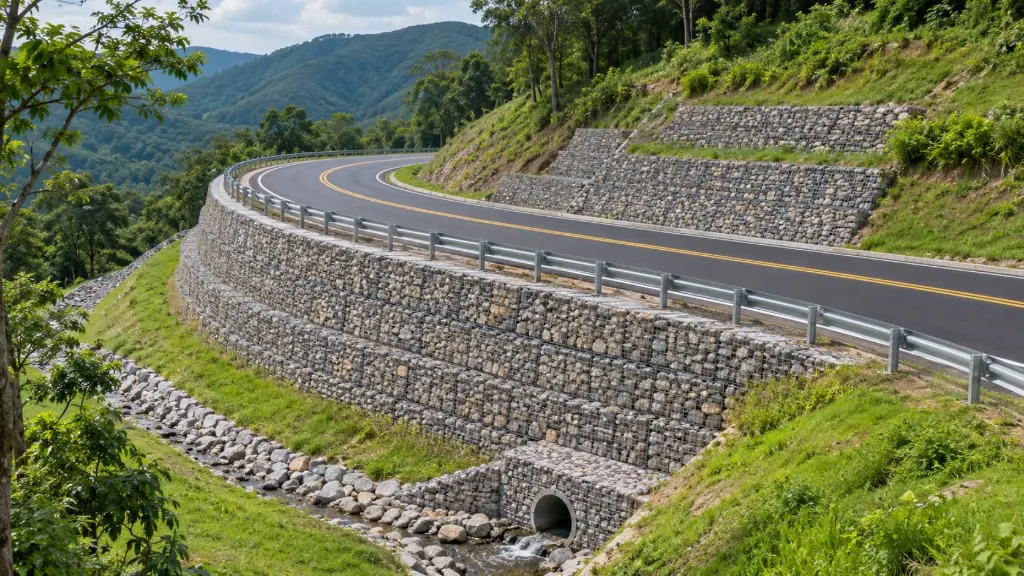
Main Applications of Gabions in Saudi Road and Highway Projects
1. Road Embankment Retaining Walls
Roads constructed across uneven terrain may require retaining structures to support elevated embankments or stabilise changes in ground level.
Gabion retaining walls can be considered for suitable locations where their weight, flexibility and drainage characteristics meet the design requirements. They may help retain soil along road corridors, access roads and infrastructure developments.
The design must account for earth pressure, traffic surcharge, groundwater conditions, foundation bearing capacity, sliding, overturning and overall slope stability. Where vehicles or heavy equipment operate close to the wall, the associated loads must be included in the engineering assessment.
2. Slope and Cut Slope Protection
Road construction in hilly or sloping areas can expose soil and rock surfaces to erosion and instability. Rainfall runoff may remove loose material, while changes in ground conditions can contribute to localised slope movement.
Gabion systems may be used as part of a wider slope protection solution. Depending on the site, this could involve retaining structures at the slope toe, surface protection or a combination of gabions with drainage and soil stabilisation measures.
Gabions should not be treated as a substitute for geotechnical investigation. The slope's geological conditions, groundwater behaviour and potential failure surfaces must be assessed before selecting a protection system.
3. Culvert Outlet and Drainage Protection
Road drainage systems collect and discharge stormwater through culverts, channels and other structures. Where water exits a culvert at high velocity, it can erode the surrounding soil and undermine the outlet.
Gabion mattresses can be used in suitable locations to protect channel beds and outlet areas against erosion. Gabion structures may also help stabilize adjacent channel banks.
The design should consider discharge velocity, flow depth, turbulence, potential scour and the transition between the protected and unprotected surfaces. Poorly designed transitions can create new erosion points downstream.
4. Bridge Approach and Abutment Protection
Bridge approaches connect road embankments to bridge structures and can be vulnerable to erosion and settlement. In locations exposed to flowing water, the surrounding soil may be affected by scour or concentrated runoff.
Gabions may be incorporated into selected bank protection or erosion control works near bridge approaches and abutments. Their use must be coordinated with the bridge design and hydraulic assessment.
Protection measures should account for expected flood conditions, foundation exposure, water flow direction and possible debris accumulation. Any proposed gabion system must also avoid interfering with the bridge's structural components or drainage arrangements.
5. Wadi Crossing and Channel Stabilisation
Many road corridors in Saudi Arabia cross wadis and natural drainage paths. During heavy rainfall, these channels may carry substantial runoff, creating erosion risks for road embankments and nearby structures.
Gabion baskets and mattresses can provide protection for selected channel banks, beds and embankment sections. They may also be used in engineered channel stabilisation arrangements where the hydraulic and geotechnical conditions are suitable.
The design should consider peak flow, channel geometry, sediment movement, scour depth and the possibility of flow overtopping or bypassing the protection.
Which Gabion System Is Suitable for Road Projects?
The correct system depends on the intended engineering function. A retaining structure requires a different configuration from a low profile channel protection mattress.
Gabion system | Potential road construction application | Main purpose |
Gabion baskets | Roadside retaining walls and embankment support | Soil retention and structural support |
Gabion mattresses | Drainage channels and culvert outlets | Surface erosion and scour protection |
Reno type mattresses | Selected hydraulic protection works | Flexible channel bed and bank protection |
Engineered gabion structures | Selected slope and channel applications | Combined stabilisation and erosion control |
Project specifications should define the required unit dimensions, mesh aperture, wire diameter, coating, connection details, stone grading and installation method. These details should not be selected solely on the basis of general product descriptions.
Important Design Considerations for Highway Gabions
Geotechnical Investigation and Foundation Preparation
The performance of a gabion structure depends heavily on the supporting ground. Before construction, the project team should evaluate soil strength, foundation conditions, settlement potential and groundwater behaviour.
The foundation should be prepared according to the approved drawings. Weak or unsuitable material may require removal, replacement or other ground improvement measures.
Traffic Loads and Structural Stability
Gabion retaining walls beside highways may be exposed to traffic surcharge and loads from nearby infrastructure. The design should consider these additional forces alongside earth pressure and other relevant loading conditions.
Stability checks may include sliding, overturning, bearing capacity and overall slope stability. The appropriate analysis depends on the geometry and function of the proposed structure.
Hydraulic Design and Scour Protection
Drainage and flood related applications require an assessment of water flow and erosion potential. Engineers should evaluate the expected discharge, velocity, water depth and possible scour around the structure.
Where water flows near a gabion installation, suitable toe protection, embedment and channel transitions should be incorporated into the design as required.
Wire Coating and Environmental Exposure
Gabion mesh must be suitable for the exposure conditions of the project. In Saudi Arabia, these may include high temperatures, coastal conditions, moisture and industrial environments.
The project specification should identify the required metallic coating and any additional protective coating. Product documentation should confirm that the supplied materials meet the approved requirements.
Stone Quality and Filter Materials
Stone filling should be durable, clean and compatible with the mesh aperture. The grading and shape should support stable filling and reduce the risk of stone loss.
Where fine soil could migrate through the gabion structure, a suitable geotextile or engineered filter layer may be necessary. Filter selection should be based on the soil grading and hydraulic requirements rather than applied as a standard assumption.
Gabions Compared with Concrete Retaining Systems
Gabions and concrete structures serve different engineering purposes, and the best option depends on project requirements.
Gabions offer a permeable stone filled construction that can accommodate some differential movement. Their modular units may also provide practical advantages during transportation and installation, particularly in locations where conventional construction access is limited.
Concrete retaining systems may be more appropriate where a rigid structure, specific geometry or other structural requirements govern the design. However, foundation conditions, drainage and construction methods must also be considered.
For highway projects, the comparison should include structural performance, hydraulic conditions, durability, construction access, maintenance and whole life cost. In some cases, both materials can be used within the same infrastructure project for different functions.
Gabion Installation and Quality Control in Road Projects
Installation should follow approved drawings, project specifications and the manufacturer's instructions. The process generally begins with excavation and foundation preparation, followed by placement and assembly of the mesh units.
The units must be connected properly and positioned to maintain the intended geometry. Where diaphragms are specified, they should be secured before filling. Stone should be placed carefully to minimise large voids and excessive mesh deformation.
For retaining structures, backfilling and compaction should follow the approved construction sequence. Heavy equipment should not damage or distort the gabion units during these operations.
Quality inspections should cover foundation preparation, mesh condition, connections, stone grading, filling arrangement, filter installation and final alignment. Records of material approvals and completed work should be maintained for project handover.
Benefits of Gabions for Saudi Road Infrastructure
When properly designed for their intended application, gabions can offer several practical benefits:
- Drainage: Their permeable structure allows water to pass through the stone filling, subject to appropriate filter design.
- Flexibility: They can accommodate some differential movement without behaving like a fully rigid structure.
- Erosion protection: Suitable gabion systems can protect selected embankments, channels and drainage outlets.
- Modular construction: Units can be assembled and installed in stages.
- Material integration: Stone filled structures can suit infrastructure locations where locally approved stone is available.
These advantages depend on engineering design, material quality, installation practices and site conditions. They should not be interpreted as guarantees of performance in every road application.
Frequently Asked Questions
Conclusion
Gabion systems can contribute to safer and more durable road infrastructure when used in appropriate retaining, slope protection and erosion control applications. Across Saudi Arabia, they may provide practical solutions for embankments, drainage channels, culvert outlets, bridge approaches and selected wadi crossings.
The success of a road gabion installation depends on more than selecting the right basket or mattress. Geotechnical investigation, hydraulic assessment, structural design, suitable materials and installation quality all play important roles.
Hitech Gabion supports contractors, consultants and infrastructure developers evaluating gabion systems for road construction, retaining structures and erosion control projects. Contact the team to discuss project requirements and request relevant product information.