Gabion basket specifications determine the quality, durability, and suitability of a gabion system for a particular project. Although a gabion basket may look like a simple wire mesh container, its performance depends on the mesh configuration, wire properties, protective coating, connections, diaphragms, dimensions, and stone fill.
For contractors, consultants, engineers, and procurement teams in Saudi Arabia, checking these specifications before ordering gabion baskets is important. The correct product should match the approved project drawings, environmental conditions, stone size, and intended application.
Gabion baskets are used for retaining walls, erosion control, slope protection, wadi protection, drainage works, infrastructure projects, and landscaping. Each application can require different technical considerations. This guide explains the main gabion basket specifications and what project teams should check before selecting or purchasing the product.
What Is a Gabion Basket?
A gabion basket is a manufactured wire mesh unit that is assembled and filled with suitable stone. Multiple baskets can be connected together to form larger structures such as:
- Gabion retaining walls
- Erosion-control structures
- Slope protection systems
- Channel protection
- Wadi protection
- Landscaping walls
- Infrastructure protection
The basket itself provides the containment system, while the stone provides the mass and physical structure of the completed gabion. The performance of the finished system depends on the compatibility of both components.
Why Gabion Basket Specifications Matter
Two gabion baskets can look similar but have different technical properties. Differences may include:
- Mesh opening
- Wire diameter
- Wire tensile properties
- Coating
- Basket dimensions
- Diaphragm arrangement
- Connection system
- Lacing wire
- Stone compatibility
These differences can affect the suitability of the basket for a particular environment or application. For this reason, procurement should be based on technical specifications rather than appearance or price alone.
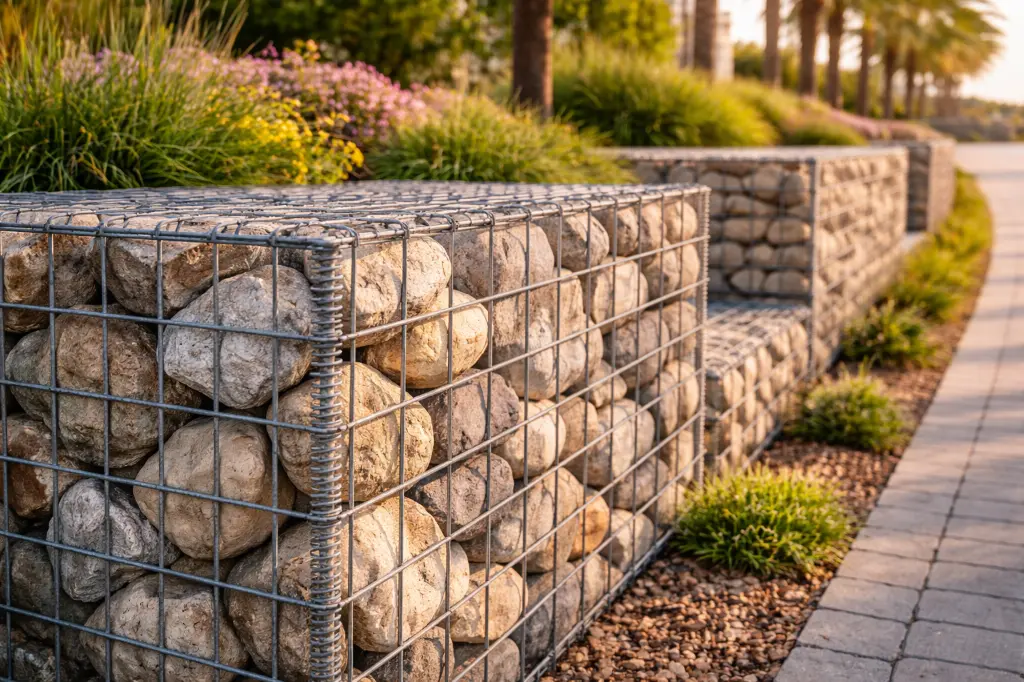
Main Gabion Basket Specifications
A project specification may identify several characteristics.
1. Mesh Type
The mesh forms the outer structure of the gabion basket. The mesh pattern and configuration influence:
- Stone retention
- Flexibility
- Basket stability
- Resistance to deformation
- Connection requirements
The selected mesh should be suitable for the intended stone size and project application.
2. Mesh Opening
Mesh opening refers to the size of the spaces within the wire mesh. The opening must be compatible with the selected stone. If the stone is too small, it can pass through the mesh. If the stone is too large, filling the basket evenly can become difficult. The mesh opening and stone grading should therefore be considered together.
3. Wire Diameter
Wire diameter affects the physical characteristics of the gabion mesh. The required diameter depends on the product system and project specification. A technical specification may identify the wire diameter separately for:
- Main mesh wire
- Selvedge wire
- Lacing wire
- Connecting wire
These components can have different requirements. The correct values should be taken from the approved product specification.
4. Wire Coating
Corrosion protection is an important consideration for gabion baskets. Common protective systems can include galvanized wire and polymer-coated wire.
The appropriate coating depends on:
- Environmental exposure
- Moisture
- Salinity
- Expected service conditions
- Project specification
This is particularly relevant for projects in coastal Saudi Arabia and locations exposed to aggressive environments.
Gabion Baskets in Coastal Saudi Arabia
Projects around the Red Sea and Arabian Gulf can experience increased exposure to saline and humid conditions. For such projects, the wire protection system should be selected according to the specified environmental requirements. Areas such as:
- Jeddah
- Yanbu
- Dammam
- Jubail
may require particular attention to corrosion protection depending on the project's exact location and exposure. The final coating specification should come from the approved project requirements.
5. Gabion Basket Dimensions
Gabion baskets are manufactured in different sizes. A specification may identify:
- Length
- Width
- Height
- Diaphragm spacing
- Mesh configuration
The selected dimensions depend on the application. A basket used in a retaining wall may be configured differently from one used in an erosion-control or landscaping application. The basket dimensions should therefore be coordinated with the wall drawings and quantity schedule.
6. Diaphragms
Diaphragms divide a gabion basket into internal compartments. They help maintain the basket's shape and provide additional internal structure.
Depending on the product design, diaphragms may be positioned at specified intervals along the basket. They can be particularly important for longer gabion units. The diaphragm arrangement should be clearly identified in the technical specification.
7. Selvedge Wire
The perimeter of a gabion mesh panel can incorporate a heavier or reinforced edge wire known as the selvedge wire. This helps strengthen the edges of the mesh and provides a suitable area for connections. The selvedge wire specification should be checked alongside the main mesh wire.
8. Lacing Wire
Lacing wire is used to connect and close gabion units. It can be required for:
- Assembling the basket
- Connecting adjacent panels
- Securing lids
- Joining gabion units
- Connecting courses
The lacing wire should be compatible with the gabion system and environmental requirements.
9. Connecting Components
Some gabion systems use mechanical connection components instead of or in addition to traditional lacing wire. These can include:
- Clips
- Spirals
- Rings
- Connectors
- Other approved fastening systems
The connection method should be consistent with the manufacturer's product system and project specification.
Gabion Basket Stone Requirements
The stone is not a secondary component of the gabion system. It provides the mass of the completed structure and must remain securely contained within the mesh. The stone should generally be:
- Durable
- Hard
- Weather resistant
- Appropriate in size
- Compatible with the mesh opening
- Suitable for the project environment
The final stone requirements should be specified by the project documentation.
Why Mesh Opening and Stone Size Must Match
The relationship between the mesh opening and stone size is particularly important. Consider a project where the mesh opening is relatively large but the selected stone contains many pieces that are smaller than the opening.
Those smaller pieces may migrate through the mesh. On the other hand, excessively large stones can create difficulties during filling and may leave undesirable voids. The contractor should therefore verify the stone grading before filling the baskets.
Gabion Basket Technical Data Sheet
A supplier technical data sheet should provide enough information for the project team to evaluate the product. Depending on the system, it may include:
Specification | Information to Verify |
Mesh type | Approved configuration |
Mesh opening | Project requirement |
Wire diameter | Product specification |
Coating | Required corrosion protection |
Basket length | Selected size |
Basket width | Selected size |
Basket height | Selected size |
Diaphragms | Spacing and arrangement |
Lacing wire | Specification |
Connections | Approved system |
Stone | Required size and quality |
The exact values should be taken from the selected manufacturer's approved technical documentation.
Gabion Basket Specifications for Retaining Walls
Retaining-wall applications require careful coordination between the basket specification and the overall wall design. The project team should consider:
- Wall height
- Base width
- Wall batter
- Soil conditions
- Surcharge
- Foundation
- Drainage
- Stone
- Wire specification
- Corrosion protection
The basket specification should support the approved wall configuration. Selecting a basket simply because it is commonly available does not confirm that it is suitable for the retaining-wall design.
Gabion Basket Specifications for Erosion Control
Gabion baskets can be used in erosion-control applications where a robust stone-filled structure is required. Applications can include:
- Bank protection
- Drainage channels
- Wadi edges
- Culvert protection
- Slope protection
- Infrastructure protection
However, shallow hydraulic protection may require a different gabion product, such as a Reno mattress. The product should therefore be selected according to the hydraulic and erosion-control requirements of the project.
Gabion Baskets vs Gabion Boxes
The terms are sometimes used interchangeably, but project documentation should use the terminology defined by the selected product system. A gabion basket or box generally refers to a wire mesh container filled with stone. The important point for procurement is not the terminology alone. The supplier and contractor should agree on:
- Dimensions
- Mesh
- Wire
- Coating
- Connections
- Diaphragms
- Stone requirements
This avoids confusion when different suppliers use different product names for similar systems.
Gabion Basket Specifications for Saudi Arabia
Saudi Arabia's diverse environment means that the product specification should reflect the actual project conditions.
Inland Construction
Projects around Riyadh and other inland locations should consider local soil, drainage, temperature, and project-specific environmental conditions.
Coastal Construction
Coastal projects may require greater attention to corrosion protection because of saline exposure.
Industrial Projects
Industrial developments may have additional requirements relating to site loads, environmental exposure, and infrastructure protection.
Mountain and Slope Projects
Mountainous projects may require gabion systems as part of a broader slope stabilization strategy.
Wadi Projects
Wadi projects require careful consideration of water flow, erosion, stone stability, and foundation conditions.
Galvanized vs Polymer-Coated Gabion Wire
The choice of coating depends on the project requirements.
Galvanized Wire
Galvanized wire provides zinc-based corrosion protection and is commonly used for gabion systems.
Polymer-Coated Wire
A polymer coating can provide an additional protective layer over the underlying wire. The appropriate option depends on the required environmental performance, project specification, and expected exposure. The coating should be specified rather than selected solely on the basis of appearance.
What Engineers Should Check Before Approving Gabion Baskets
Before approving a gabion basket for a project, verify:
Product
- Basket dimensions
- Mesh type
- Mesh opening
- Wire diameter
- Selvedge wire
- Diaphragms
Protection
- Coating type
- Coating requirements
- Environmental suitability
Connections
- Lacing wire
- Connectors
- Lid closure
- Basket-to-basket connections
Stone
- Size
- Durability
- Compatibility with mesh
Documentation
- Technical data sheet
- Product specifications
- Relevant test documentation
- Manufacturer information
What Contractors Should Check Before Installation
Before installation begins, the contractor should verify that the delivered materials match the approved specification. Check:
- Basket dimensions
- Mesh condition
- Wire coating
- Connection materials
- Diaphragms
- Stone size
- Stone quality
- Quantity
- Approved drawings
- Installation requirements
Any damaged or non-conforming material should be identified before it becomes part of the completed structure.
Gabion Basket Quality Inspection
Quality inspection should begin before installation. The project team can visually check for:
- Damaged mesh
- Broken wires
- Damaged coating
- Incorrect dimensions
- Missing diaphragms
- Missing connection materials
- Improper packaging or handling damage
For projects with formal inspection requirements, the inspection should follow the approved quality-control plan and applicable project specifications.
How to Choose a Gabion Basket Supplier in Saudi Arabia
For Saudi projects, procurement teams should evaluate suppliers based on more than product availability. Consider:
- Technical specifications
- Product consistency
- Wire coating
- Available dimensions
- Connection systems
- Stone compatibility
- Technical documentation
- Supply capacity
- Delivery capability
- Project experience
- Technical support
The supplier should be able to clearly identify the product being offered and provide documentation suitable for project review.
Why Choose Hitech Gabion?
Hitech Gabion provides gabion and earth-retention solutions for construction and infrastructure applications in Saudi Arabia. Its product and solution range supports applications including:
- Gabion baskets
- Gabion boxes
- Retaining walls
- Slope protection
- Erosion control
- Wadi protection
- Reno mattresses
- Infrastructure protection
- Landscaping
Hitech Gabion can support project teams looking for gabion systems and technical product information for Saudi construction projects. For each project, the final basket specification should be coordinated with the approved engineering drawings, environmental conditions, stone requirements, and project specifications.
Conclusion
Gabion basket specifications determine whether a product is appropriate for its intended application. The mesh opening, wire diameter, coating, basket dimensions, diaphragms, connections, and stone compatibility should all be reviewed before procurement.
For Saudi Arabia projects, environmental exposure is another important consideration, particularly where gabion systems are installed near coastal areas, wadis, drainage channels, or demanding infrastructure environments.
A properly specified gabion basket provides the foundation for a reliable completed gabion system. However, the product should always be selected as part of the approved engineering and construction requirements rather than in isolation.
Hitech Gabion supplies gabion and earth-retention solutions for Saudi construction and infrastructure applications, supporting project teams with gabion products suitable for retaining, erosion-control, slope-protection, and related applications.
Frequently Asked Questions
The main specifications can include mesh type, mesh opening, wire diameter, coating, basket dimensions, diaphragms, selvedge wire, lacing wire, connection system, and stone requirements.
Gabion baskets use steel wire mesh with a protective coating selected according to the product and project requirements. Galvanized and polymer-coated systems are commonly considered.
The mesh opening depends on the selected gabion system and application. It must be compatible with the specified stone size.
Many gabion basket systems use internal diaphragms to divide longer units and help maintain their shape. The required arrangement depends on the selected product.
The stone should be appropriately sized so that it remains within the mesh while allowing the basket to be filled effectively. The final stone grading should follow the project specification.
They can be suitable for many applications, but the required corrosion protection depends on the project environment and specification. Coastal or aggressive environments may require additional protection.
The terminology varies between suppliers and product systems. Both generally refer to wire mesh containers filled with stone. The technical dimensions and specifications should be confirmed from the manufacturer's documentation.