Gabion mesh is a key component of gabion baskets, retaining walls, slope protection systems, and erosion control structures. Its wire type, mesh opening, coating, and manufacturing quality directly affect the strength, durability, and service life of the finished structure.
In Saudi Arabia, selecting the right gabion mesh requires careful consideration of project location, soil conditions, drainage requirements, exposure to moisture, and the specifications provided by the project consultant. Coastal environments, desert conditions, and infrastructure projects can place different demands on wire mesh and its protective coating.
This guide explains the main types of gabion mesh, common sizes, wire coatings, and selection factors for construction and infrastructure projects across the Kingdom.
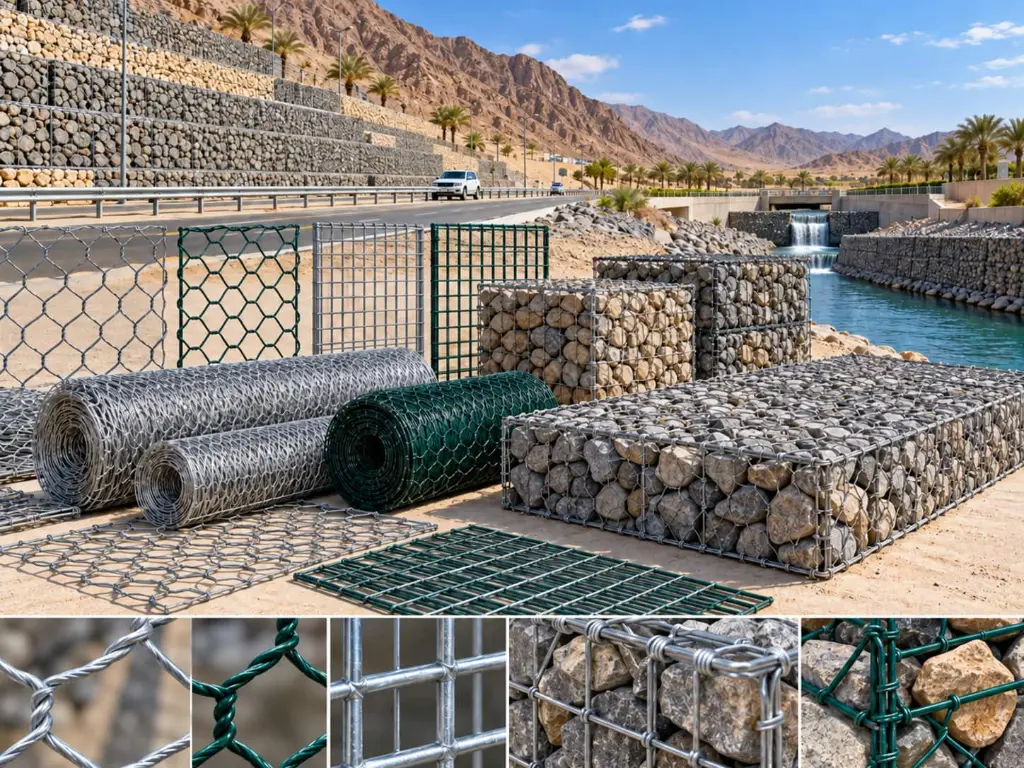
What Is Gabion Mesh?
Gabion mesh is a woven or welded wire structure used to form containers that are filled with stones or other approved materials. Once filled and installed, these units can provide retaining support, erosion resistance, slope stabilization, and architectural landscaping features.
The mesh holds the stone fill in place while allowing water to pass through the structure. This permeability can help reduce hydrostatic pressure behind retaining structures when the gabion system is designed and installed correctly.
Gabion mesh is commonly supplied in rolls, panels, or prefabricated basket units. The appropriate format depends on the product design, installation method, project dimensions, and required performance.
Main Types of Gabion Mesh
1. Double-Twisted Hexagonal Gabion Mesh
Double-twisted hexagonal mesh is manufactured by twisting pairs of steel wires together to create a flexible network of hexagonal openings. This construction helps the mesh retain its integrity when subjected to localized wire damage or movement, although the actual performance depends on the product specification and installation.
It is commonly used for gabion baskets, retaining walls, riverbank protection, and slope stabilization. Its flexibility can be useful on projects where settlement or ground movement is anticipated. For infrastructure projects in Saudi Arabia, buyers should confirm the mesh opening, wire diameter, coating type, tensile properties, and compliance with the project's specified standard.
2. Welded Gabion Mesh
Welded gabion mesh consists of steel wires joined at their intersections to create a regular grid. It generally offers a uniform appearance and can simplify assembly where rigid panels are suitable.
Welded mesh is frequently considered for landscape walls, decorative gabions, garden boundaries, and selected civil engineering applications. However, the suitability of a welded system for a retaining wall or other structural application must be established through the project design and product specifications.
The wire diameter, weld quality, corrosion protection, panel dimensions, and connection details should be checked before procurement.
3. PVC-Coated Gabion Mesh
PVC-coated mesh has a polymer layer over the underlying protective metal coating. The additional layer can improve resistance to environmental exposure and abrasion when the coating system is correctly specified for the intended conditions.
This option may be considered for projects exposed to moisture, saline conditions, or other corrosive environments, including certain coastal locations in Saudi Arabia. The performance of the complete system depends on the base wire, metallic coating, polymer quality, coating thickness, and potential damage during transportation and installation.
PVC-coated products should be selected according to the project specification rather than assumed to be suitable for every coastal or marine application.
Common Gabion Mesh Sizes and Specifications
Gabion mesh is available in different opening sizes and wire diameters. The correct combination depends on basket dimensions, stone grading, structural requirements, and applicable project standards.
| Specification | Common Options or Considerations |
|---|---|
| Mesh Opening | 60 × 80 mm, 80 × 100 mm, or 100 × 120 mm for some double-twisted systems |
| Wire Diameter | Often approximately 2.0–3.9 mm, depending on the mesh type and design |
| Coating | Galvanized, zinc-aluminium alloy, or metallic coating with an additional polymer layer |
| Mesh Form | Double-twisted rolls, welded panels, or prefabricated basket units |
| Basket Dimensions | Selected according to wall height, width, length, and engineering design |
| Stone Fill | Sized to suit the mesh opening and project requirements |
Why Mesh Opening Size Matters
The mesh opening must be compatible with the stone fill. If the openings are too large relative to the smallest stones, the fill may escape through the mesh. If the openings are unnecessarily small, material use and installation requirements may increase.
Stone grading should therefore be coordinated with the mesh specification before ordering. The design should also consider the required wall geometry, expected loads, drainage, and the possibility of stone movement during placement.
Wire Coatings and Corrosion Protection
Corrosion protection is especially important when selecting gabion mesh for long-term infrastructure projects. Although gabions are often used in exposed outdoor environments, their service life depends on the wire material, coating quality, site conditions, and maintenance requirements.
Galvanized Gabion Mesh
Galvanized mesh uses a zinc coating to protect the underlying steel. Zinc provides a protective barrier and can offer sacrificial protection when the steel is exposed through minor coating damage.
Galvanized products are commonly considered for retaining walls, landscaping, slope protection, and general civil engineering works. However, coating mass or thickness should be checked against the specified product standard and environmental exposure.
Zinc-Aluminium Alloy Coating
Some gabion systems use zinc-aluminium alloy coatings to provide enhanced corrosion resistance compared with certain conventional zinc-coated products. The exact performance depends on the alloy composition, coating specification, and conditions at the installation site.
For projects near the Red Sea or Arabian Gulf, the consultant should evaluate the expected chloride exposure and specify a coating system appropriate to the environment.
Polymer-Coated Wire
Polymer-coated gabion wire combines a metallic protective coating with an outer polymer layer. It can offer an additional barrier against environmental exposure, but damaged or cut coating can reduce its protective performance.
During installation, workers should avoid unnecessary abrasion, dragging, or impact that could damage the coating. Cut ends, connectors, and lacing wire should also meet the project's corrosion protection requirements.
Important: The most suitable coating cannot be determined from location alone. Coastal exposure, soil chemistry, water conditions, design life, and the relevant project standard should all be considered.
Standards and Quality Checks for Saudi Projects
Gabion mesh should be procured against the standards stated in the project specification. Depending on the product and application, the consultant may reference standards such as EN 10223-3 for hexagonal steel wire netting for civil engineering purposes, alongside relevant requirements for wire coatings, mechanical properties, dimensions, and workmanship.
Before approving a supplier, contractors and procurement teams should request technical documentation covering:
- Wire diameter, mesh opening, and dimensional tolerances.
- Metallic coating type and the applicable coating test requirements.
- Polymer coating details, where applicable.
- Tensile properties and mesh construction.
- Basket connections, lacing wire, diaphragms, and assembly details.
- Product inspection records and certificates required by the project.
A supplier's general product brochure may not be sufficient for a major infrastructure project. The submitted technical data should match the approved drawings, bill of quantities, and consultant requirements.
How to Choose Gabion Mesh for Projects in Saudi Arabia
Choosing gabion mesh starts with understanding its intended use. A decorative garden wall may have different requirements from a retaining structure supporting a road embankment or a slope protection system exposed to flowing water.
For retaining walls, the engineer should establish the required basket configuration, wall geometry, foundation conditions, drainage, and stability requirements. For channel or riverbank protection, the design should consider flow velocity, scour, stone grading, and the expected hydraulic conditions.
In coastal areas, corrosion protection deserves additional attention because salt exposure can accelerate deterioration of unsuitable materials. In desert locations, temperature variation, windblown sand, and handling conditions may also influence product selection and installation practices.
Contractors should confirm the specifications before ordering and inspect delivered material for coating damage, deformation, incorrect dimensions, or missing accessories. Correct installation is just as important as mesh quality: baskets must be assembled, connected, braced, and filled according to the approved design.
Where Is Gabion Mesh Used in Saudi Arabia?
Gabion mesh is used in several types of construction and landscape projects across Saudi Arabia. Roads and infrastructure: Gabion systems can support designed retaining structures and protect selected embankments from erosion. Their use should be based on geotechnical and structural requirements.
Slope stabilization: Properly designed gabion installations can help manage erosion and retain soil on suitable slopes. Drainage and foundation preparation remain essential.
Water management: Gabions and related systems can be used for channel lining, bank protection, and erosion control where the hydraulic design supports their use.
Landscaping and site development: Welded or woven gabion products can create landscape walls, boundary features, and architectural elements, subject to the intended load and durability requirements.
For each application, the mesh system should be selected according to its engineering function rather than appearance alone.
Frequently Asked Questions
There is no single best option for every project. Double-twisted mesh is widely used in civil engineering applications, while welded mesh may suit selected landscaping and architectural projects. The final choice depends on design requirements, site exposure, coating, and the applicable specification.
It may be suitable in some coastal applications, but the coating system must be assessed against the expected salt exposure and required design life. Some projects may require a more protective coating system or additional measures specified by the engineer.
Mesh opening should be selected alongside the wire diameter, basket design, and stone grading. The smallest stones must be compatible with the opening so they remain contained, and the complete system must meet the project requirements.
Confirm the mesh type, opening size, wire diameter, coating, basket dimensions, accessories, applicable standards, and technical documentation. For structural applications, ensure the product matches the approved design and bill of quantities.
Yes. Gabion systems are used for retaining walls when designed for the relevant soil conditions, loads, drainage, foundation, and stability requirements. Product selection and installation should follow the approved engineering design.