The Saudi Arabian urban and infrastructure environment is growing in size, and retaining walls and slope protection structures are necessary. However, when deciding on a project, there is one major comparison that comes to mind; should you use gabions or concrete?
These two materials have distinct structural and financial connotations particularly in the hot and dry climate of the Kingdom. The increasing number of requirements in sustainability, cost-effective, and low-maintenance solutions have made engineers and architects reevaluate the conventional approaches.
The article under analysis is a cost-benefit analysis of the options between a gabion and concrete retaining wall concerning financial savings, long-term construction, and climate flexibility, which are the main determinants of the success of the project in Saudi Arabia.
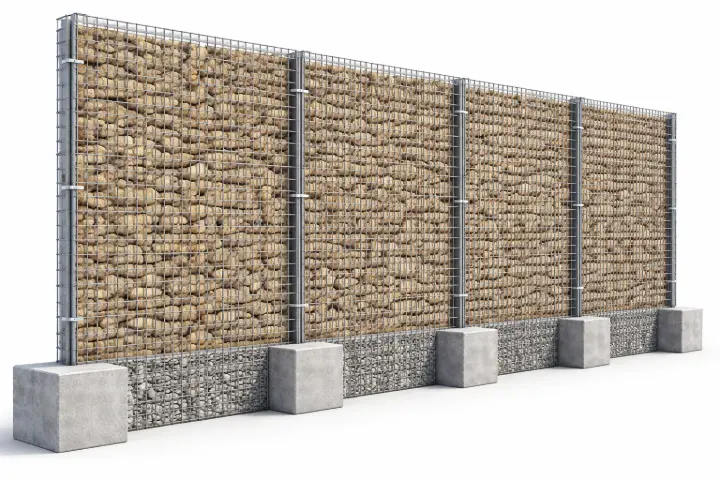
Economical Savings using Gabions.
Among the main factors that make developers in Saudi Arabia turn towards gabion systems is the financial savings that can be realised in the course of installation and in the long term maintenance.
Cost Efficiency
- Reduced Material Costs: Gabion baskets are lighter to carry and can be stuffed with stones that are locally available, and it saves a lot of money.
- Low Labor exigencies: Gabions as compared to concrete do not require the use of form work, mixes, and curing as they are easy to construct; this saves time and manpower.
- Less Maintenance: Gabion structures are inherently flexible to ground movement, i.e. there is no need to repair cracks or strengthen the structure with expensive reinforcing structures.
In large-scale infrastructural projects (highways or wadi protection systems), it is possible to save up to 40 percent of the cost of retaining walls made of concrete instead of using gabion walls.
Understanding the Materials: A Quick Comparison
A quick comparison of Gabion Retaining Walls and Concrete Retaining Walls, highlighting key differences and cost ranges.
| Feature | Gabion Retaining Walls | Concrete Retaining Walls |
|---|---|---|
| Material Composition | Wire mesh baskets filled with stones or aggregates | Cement, sand, aggregate, and steel reinforcement |
| Installation Time | Fast, flexible, and modular | Requires curing time and formwork |
| Drainage Capability | Naturally permeable, no extra drainage system needed | Requires weep holes or drainage design |
| Maintenance | Minimal, self-adjusts to ground movement | Requires repair if cracks or erosion occur |
| Environmental Impact | Eco-friendly, uses local stone | High carbon footprint due to cement |
| Cost Range (per metre) | SAR 350 – 750 | SAR 600 – 1,200 |
Suitability for the local harsh, dry climate.
The climate in Saudi Arabia is unique, as it is hostile and dry. The heat is severe, flash floods appear here occasionally, sand erosion. That's why the materials that are used in retaining walls should be able to withstand these extremities.
Why Gabions Success in such Circumstances
- Temperature Resistance: Gabion wires that are either galvanized or PVC coated can be used in high temperatures without structural failure.
- Permeability: Gabion walls are permeable to water that will eliminate hydrostatic pressure which cracks concrete.
- Flexibility to Sand Shifts: Gabions naturalize with the movement of soil, whereas hard concrete walls tend to break.
- Eco-Integration: They are mixed with natural environment which facilitates growth of vegetation in stabilising the soil in the long run.
In this way, comparing the applicability to the local severe, dry climate, it is evident that gabions would be superior compared to concrete because of their strength and adaptability.
Performance and Sustainability Long-term.
Concrete buildings are not as tough as they may seem, and in the course of time, the stress and moisture permeation cause the structures to crumble, particularly in arid areas. On the contrary, the gabions enhance with time as the compacting soil and plants strengthen the structure.
Gabions Provide
- It will last many decades, and with minimal care.
- Local materials should be used sustainably and polluting the transport should be reduced.
- Natural drainage, erosion behind the wall is eliminated.
Gabions as an easy and environmentally friendly proposition to long term developments of the Kingdom.
Maintenance and Lifecycle Cost Comparison
A cost comparison between Gabion Walls and Concrete Walls, highlighting initial costs, maintenance frequency, lifespan, drainage requirements, and overall lifecycle cost.
| Parameter | Gabion Walls | Concrete Walls |
|---|---|---|
| Initial Cost | Lower | Higher |
| Maintenance Frequency | Very low | Moderate to high |
| Lifespan (Years) | 50+ with coating | 25–40 with repair |
| Drainage Requirement | None | Needs design integration |
| Overall Lifecycle Cost | ~40% less than concrete | Higher due to repair cycles |
Case Study: Hitech Gabion in a Riyadh infrastructure Project.
A recent project by Hitech Gabion involved supplying and installing the retaining structures of a drainage channel in the Riyadh industries. The engineers were able to use galvanized gabion baskets instead of poured concrete because of cost and time limitations.
The results were clear
- Overall cost savings: 38 percent of concrete.
- Installation time: Saved 45% on time.
- No structural damage following two rainy seasons.
The selected case highlights the fact that the selection of gabions can save money and be sustainable without sacrificing strength and the look.
Flexibility of design and Beauty.
Besides being economical in performance, the use of gabions gives the freedom of design that is impossible with concrete. In the case of villas, resorts, and landscape projects in cities such as Riyadh, Jeddah and Dammam, architects have been relying on gabions due to their natural stone texture and modular outlook.
Concrete can be seen as very monotonous and industrial, and gabions add visual balance to the surroundings of deserts, particularly when stuffed with local basalt or limestone. Another possibility of adding vegetation also turns these walls into living and green walls- something that could not happen with concrete.
Considerations
Although gabions are suited in most projects, they also have some considerations:
- Certify the quality of wire coating to prevent corrosion.
- Should be packed in with well graded stones.
- Large-scale installations require experienced work.
Nevertheless, they can be easily controlled with the help of experienced suppliers such as Hitech Gabion which provides the opportunity to meet the international engineering standards in every project.
Final Thoughts
Gabions are more prudent and appropriate to the local harsh and arid climate, when compared with financial savings and appropriateness in infrastructure development in Saudi Arabia.
Gabions in contrast to rigid concrete are a combination of engineering performance, natural appearance and integration with the environment appearance, and thus they are ideal in keeping retaining walls, drainage system, and desert landscaping.
Contact Hitech Gabion today to receive assistance with design and cost estimates and support of any project depending on your landscape and construction objectives.