Gabion mesh is the wire mesh used to form gabion baskets, gabion boxes, and other stone-filled erosion-control structures. The mesh holds the stone in place while allowing the completed structure to remain permeable and adapt to minor ground movement.
For construction projects in Saudi Arabia, choosing the correct gabion mesh requires more than checking the mesh opening. Wire diameter, mesh configuration, coating, basket dimensions, connection method, stone size, and environmental exposure all need to match the intended application.
Gabion mesh is used in retaining walls, slope protection, erosion control, wadi protection, drainage works, road infrastructure, landscaping, and other civil engineering applications. This guide explains the main types of gabion mesh, the specifications that matter, and how project teams can select the appropriate mesh for Saudi projects.
What Is Gabion Mesh?
Gabion mesh is a wire mesh system designed to contain stone within a gabion structure. The mesh forms the outer cage, while the stone provides the mass and bulk of the finished structure. Depending on the product system, gabion mesh can be used to manufacture:
- Gabion baskets
- Gabion boxes
- Gabion retaining units
- Reno mattresses
- Erosion-control structures
The mesh must be strong enough and appropriately protected for the conditions in which the completed system will operate.
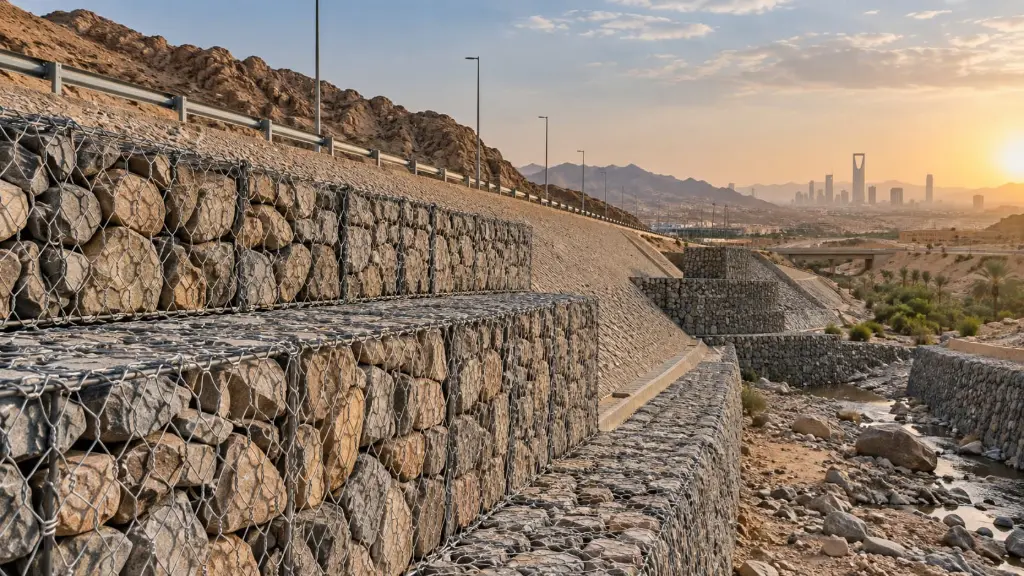
How Gabion Mesh Works
A gabion structure combines three important components:
Wire mesh + connection system + stone fill
The mesh contains the stone. The connections join individual panels and baskets. The stone provides the weight and physical mass of the completed structure. The performance of the finished gabion therefore depends on the compatibility of all three components rather than the mesh alone.
Main Gabion Mesh Specifications
When evaluating gabion mesh, project teams should review several technical characteristics. These commonly include:
- Mesh opening
- Wire diameter
- Mesh configuration
- Edge wire
- Coating
- Basket dimensions
- Connection system
- Diaphragm arrangement
- Stone compatibility
The exact requirements should come from the approved project specification and selected product system.
Gabion Mesh Opening
Mesh opening is the size of the spaces formed by the intersecting wires. The opening needs to be compatible with the stone used to fill the gabion. If the stone is too small relative to the opening, smaller pieces may escape through the mesh. If the stone is excessively large, filling can become difficult and the basket may not achieve a consistent shape. For this reason, mesh opening and stone grading should always be reviewed together.
Gabion Mesh Wire Diameter
Wire diameter refers to the thickness of the wire used to manufacture the mesh. The required diameter depends on the product specification and application. The project documentation may specify different wire sizes for:
- Main mesh
- Edge or selvedge wire
- Lacing wire
- Connecting wire
These components should not automatically be assumed to have identical specifications. The actual wire diameter should be confirmed from the manufacturer's technical documentation.
Gabion Mesh Edge Wire
The perimeter of a gabion mesh panel can use a stronger edge wire to reinforce the panel. This is commonly referred to as a selvedge or edge wire. It can provide a stronger boundary for:
- Panel connections
- Basket assembly
- Lid closure
- Adjacent unit connections
The edge wire should be compatible with the main mesh and project requirements.
Gabion Mesh Coating
The wire coating protects the steel from corrosion. The appropriate protection depends on the environmental conditions and project requirements. Common systems include:
- Galvanized wire
- Polymer-coated wire
- Other specified protective systems
The coating should be selected according to the expected exposure rather than simply based on appearance.
Galvanized Gabion Mesh
Galvanized gabion mesh uses a zinc coating to provide corrosion protection to the steel wire. It is widely used in civil engineering applications. The required galvanizing specification should be confirmed through the project documentation. Factors such as coating characteristics, environmental exposure, and expected service conditions should be considered when selecting the product.
Polymer-Coated Gabion Mesh
Polymer-coated gabion mesh has an additional polymer layer around the wire. This can provide an additional barrier against environmental exposure. Polymer-coated systems may be considered for projects where enhanced protection is required, subject to the project specification and manufacturer's recommendations. The coating system should always be verified before procurement.
Gabion Mesh for Retaining Walls
Gabion retaining walls rely on stone-filled mesh units to create a gravity structure. The mesh must work together with:
- Stone fill
- Wall geometry
- Foundation
- Backfill
- Drainage
- Connections
- Soil conditions
A suitable mesh specification alone does not determine whether the completed retaining wall is stable. The overall wall should follow the approved engineering design.
Gabion Mesh for Slope Protection
Gabion mesh can be used in slope-protection systems where stone-filled structures are required. Possible applications include:
- Slope stabilization
- Toe protection
- Erosion control
- Drainage-channel protection
- Embankment protection
The mesh configuration should be selected according to the slope geometry and the type of protection required. Where the objective is surface protection rather than soil retention, a Reno mattress may be more appropriate than a conventional gabion box.
Gabion Mesh for Wadi Protection
Wadis can experience rapid water movement during heavy rainfall events. Gabion systems can be incorporated into appropriate hydraulic and erosion-control designs. Potential applications include:
- Wadi banks
- Channel edges
- Culvert outlets
- Check structures
- Erosion-control works
The mesh, stone, foundation, and overall structure should be designed for the expected hydraulic conditions. A standard gabion detail should not automatically be used for a high-flow location without appropriate assessment.
Gabion Mesh for Road Projects
Road and highway projects can use gabion systems for:
- Retaining embankments
- Slope protection
- Drainage protection
- Erosion control
- Bridge approach protection
- Roadside stabilization
Road projects may also have additional requirements relating to traffic loads, construction access, drainage, and safety. The gabion mesh specification should therefore be coordinated with the complete road design.
Gabion Mesh for Landscaping
Gabion mesh is also used in landscape construction. Applications can include:
- Decorative walls
- Garden retaining walls
- Terraced landscapes
- Boundary features
- Raised planting areas
Landscape projects often place greater emphasis on stone appearance and wall proportions. However, a wall that retains soil still requires appropriate foundation and drainage consideration.
Gabion Mesh vs Welded Mesh
Gabion systems can be manufactured using different mesh configurations. Woven or mechanically formed mesh systems are commonly used for flexible gabion structures. Welded mesh systems use intersecting wires joined at fixed points. The appropriate system depends on the product design and project requirements. The selection should consider:
- Flexibility
- Shape retention
- Installation requirements
- Connection system
- Environmental exposure
- Intended application
The terms should not be treated as interchangeable when preparing a technical specification.
Double-Twisted Gabion Mesh
Double-twisted wire mesh is widely associated with flexible gabion systems. The wire configuration creates a continuous mesh structure in which the wires are mechanically joined. This type of construction can provide flexibility and help the mesh accommodate localized movement without immediately losing its overall form. For projects using double-twisted mesh, the exact mesh configuration and wire specification should be confirmed from the approved product documentation.
Gabion Mesh and Stone Compatibility
One of the most important procurement checks is compatibility between the mesh and stone. The stone should be large enough to remain contained within the mesh. At the same time, the stone should be practical to place within the basket.
The contractor should review:
Mesh opening → stone grading → basket dimensions → filling method
before construction begins. This simple coordination can prevent problems during installation.
Gabion Mesh Connection Methods
Mesh panels and completed baskets need to be connected properly. Depending on the system, connections can include:
- Lacing wire
- Clips
- Spirals
- Rings
- Mechanical connectors
The connection method should follow the selected manufacturer's system. A project specification should clearly identify the approved connection method where required.
Gabion Mesh Diaphragms
Long gabion units may contain internal diaphragms. These divide the basket into compartments and help maintain the intended shape during filling. Diaphragms can also assist with the structural organization of longer gabion units. Their spacing and arrangement should be confirmed from the product specification.
How to Select Gabion Mesh for a Project
A practical selection process starts with the application.
Step 1: Identify the Application
Determine whether the system will be used for:
- Retaining
- Erosion control
- Slope protection
- Wadi protection
- Drainage
- Landscaping
Step 2: Review Site Conditions
Consider:
- Soil
- Groundwater
- Surface water
- Terrain
- Loading
- Coastal exposure
Step 3: Confirm Wall or Structure Geometry
Review:
- Height
- Width
- Length
- Batter
- Setback
- Foundation
Step 4: Select the Mesh System
Confirm:
- Mesh opening
- Wire diameter
- Coating
- Edge wire
- Connections
- Diaphragms
Step 5: Confirm Stone
Make sure the selected stone is compatible with the mesh opening and project specification.
Gabion Mesh Quality Inspection
Gabion mesh should be inspected before installation. The inspection can include:
- Mesh dimensions
- Mesh opening
- Wire condition
- Coating condition
- Edge wire
- Connections
- Diaphragms
- Product labeling
- Quantity
The project quality-control procedure should determine the formal acceptance criteria. Any damaged or non-conforming material should be identified before installation.
Gabion Mesh Procurement Checklist
Before placing a purchase order, confirm:
- Application
- Basket type
- Mesh type
- Mesh opening
- Wire diameter
- Edge wire
- Coating
- Basket dimensions
- Diaphragms
- Connection system
- Stone requirements
- Quantity
- Technical documentation
- Delivery requirements
This checklist helps procurement teams compare quotations on a like-for-like technical basis.
Why Choose Hitech Gabion?
Hitech Gabion provides gabion and earth-retention solutions for construction and infrastructure projects in Saudi Arabia. Its solutions support applications including:
- Gabion mesh systems
- Gabion baskets
- Gabion boxes
- Retaining walls
- Slope protection
- Erosion control
- Wadi protection
- Reno mattresses
- Landscaping
- Infrastructure protection
Hitech Gabion can support project teams looking for gabion products and technical information for Saudi construction applications. The final mesh specification should always be coordinated with the approved engineering drawings, environmental conditions, stone requirements, and project specifications.
Frequently Asked Questions